





1st Edition
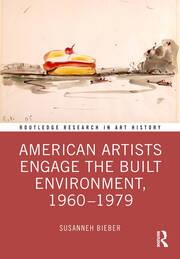
American Artists Engage the Built Environment, 1960-1979
List of Figures
List of Permissions
Acknowledgments
- Introduction: Perimeters/Pavilions/Decoys: Mary Miss
- Constructing A Better World: From the Bauhaus to Postwar America
- Twentieth Century Engineering: Donald Judd and Robert Grosvenor
- Monuments, Landmarks, and Ruins: Claes Oldenburg and Robert Smithson
- Idea as Model: Lawrence Weiner and Gordon Matta-Clark
Conclusion
Bibliography
Index
Biography
Susanneh Bieber is Assistant Professor in the School of Performance, Visualization & Fine Arts and the School of Architecture at Texas A&M University.
"Rigorously researched and highly readable, this excellent book uncovers the many fascinating sides of American art’s obsession with architecture in the 1960s and 1970s. Bieber reveals the dreams of the period while also asking how this art looks now, from the vantage of a new generation’s effort to make a better future."
--Joshua Shannon, University of Maryland
"Susanneh Bieber’s book rigorously examines the intersection of art, architecture, and urban planning. She demonstrates the many creative ways with which artists engaged zoning laws and historic preservation, and reimagined architectural plans and construction sites."
--Cécile Whiting, University of California, Irvine
"Bieber’s book is outstanding in demonstrating the relevance of architecture to art, and in convincingly organizing artistic and architectural pairings. Just as remarkable is her complication of canonical artists and established perspectives through socio-politics. She rethinks projects and legacies with perspicacity and sensitivity."
--Katherine Smith, author of The Accidental Possibilities of the City
