




1st Edition
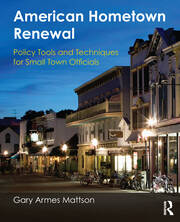
American Hometown Renewal Policy Tools and Techniques for Small Town Officials
Section 1: The Contemporary Small Town
1. New Troubles for American Towns
2. The Main Street Community
3. The Small Town Policy Domain
Section 2: Policy Planning and the Community
4. Community Visioning and Strategic Thinking
5. Thinking About Demographics
6. Community Demographic Tools
7. The American Dream and Social Mobility
Section 3: Thinking About Economic Opportunities
8. The Heartland and the New Global Economy
9. Small Towns as Economic Engines
10. Meltdown from Wall Street to Main Street.
11. Housing Policy and the American Dream
12. Community and Housing Tools
Section 4: Labor Force Analysis
13. Labor Market Dynamics
14. Employment and Workforce Analysis
15. Where the Jobs Are
16. Is Your Community Competitive?
17. Main Streets as Commercial Hubs
Section 5: Main Street’s Fiscal Component
18. Where is the Money?
19. Small City Municipal Service Framework
20. Municipal Services and Fiscal Stress
21. The Small Town Budget Process
22. Public Debt Financing
23. Comprehensive Planning and Fiscal Policy
24. Rebooting Community in the New Economy
Biography
Gary A. Mattson, Ph.D. AICP, is a charter member of the American Institute of Certified Planners, was a practitioner for 15 years, has served on several state commissions or boards, and was a college professor of public management and city planning for more than 20 years. He is currently Associate Professor of Public Administration at Northern Kentucky University, USA.
"Gary Mattson’s American Hometown Renewal is an overdue analysis of small towns’ predicaments and prospects. The sweeping methodical work testifies to the author’s knowledge of all facets of small-town life from budgets to building codes’ impacts. In a land where anecdote and ideology have blinded observers of countryside, the author demonstrates clarity of sight and presence of mind. He captures the actors, organizations, instruments, and systems that define this America, and he offers hope to those who seek changes. Mattson complements a solid theory- and numbers-based approach with much-needed color including literary references and cultural anecdotes. The result is an indispensable compendium for any scholar, official, or activist interested in the American small towns. The book should be mandatory foundational reading for all policymakers and all students in public administration programs." –Anthony J. Amato, Southwest Minnesota State University, USA
"This book provides a comprehensive account of the challenges facing small town America in the early 21st century. What sets this book apart from others is the thoroughness of the background provided, enabling city officials to fully understand the forces and policies that have given rise to the current situations that they are facing. In addition, the book provides the reader with useful tools—methods of Community Asset Assessment Analysis—that enables planners and city officials to analyze their community’s situation and thus, better understand what actions to take to bring about positive change in the future." –Susan Bradbury, Iowa State University, USA
"American Hometown Renewal is a passionate and practical guide to planning and revitalizing communities. Although focused on the experiences of smaller cities in the American Midwest heartland, the economic and social planning issues, tools, and insights presented can be applied to small towns across the country. Dr. Mattson has written an essential guide that is sensitive to the conditions and needs of small town America, while providing a focus on understanding and rejuvenating their economic vibrancy." –Alan A. Lew, Northern Arizona University, USA
"American Hometown Renewal is a vital resource for small-town leaders and officials, offering a comprehensive look at the challenges facing the Heartland’s small towns and suggestions for how to best assess and address them. Mattson recognizes the importance of place, space, and community for small-town dwellers, and focuses on including these concerns in the planning process. This book provides a vital set of tools, strategies, and analytical stances that can be used in community planning and policy making, making clear their links to civic functioning and economic and social viability. It is a must-read for those invested in the future of American small towns and their positions within the global economy." –Jennifer Sherman, Washington State University, USA
