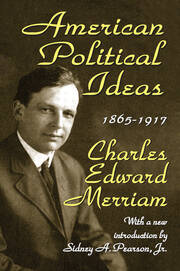
Charles Merriam is scarcely read today, and even among scholars he is probably more often cited than read seriously. His ambiguous position in the study of American democracy is unfortunate. Between the two world wars, Merriman was the doyen of American political science. This was a period when the most formative characteristics of academic social sciences were taking shape, characteristics that...
Read moreCharles Merriam is scarcely read today, and even among scholars he is probably more often cited than read seriously. His ambiguous position in the study of American democracy is unfortunate. Between the two world wars, Merriman was the doyen of American political science. This was a period when the most formative characteristics of academic social sciences were taking shape, characteristics that were to dominate the remainder of the century. During this period, "science" and "progress" became virtually synonymous in the social sciences. Between the two world wars, the liberal progressive critique of America's founders, a critique that included scholars such as Woodrow Wilson, Charles Beard, and others, became the orthodoxy of a new political science. The heart of that critique, insofar as it turned on methodological questions of how to study American government, was very much the work of Charles Merriam. Anyone who seeks to understand why that period was so pivotal in the interpretation of American democracy must necessarily study Charles Merriam and his influence. His work represents the first comprehensive effort by a scholar in the liberal-progressive tradition to survey the entirety of American political thought.
To read Merriam's political essays and writings is to read a political theory that the behavioral tradition would come to label as "normative." His essays included insightful interpretations of Hobbes and Rousseau in European political philosophy as well as an earlier work tracing American political thought from the founding to the Civil War. This is a fundamental work for scholars working in the liberal-progressive tradition.
Read less