




1st Edition
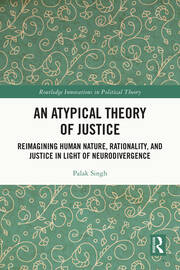
An Atypical Theory of Justice Reimagining Human Nature, Rationality, and Justice in Light of Neurodivergence
1. Conceptions of Human Nature in Western Political Philosophy: An Overview
2. Neurodiversity and Psychopathy: The Need for Inclusion in Moral Political Framework
3. Moral Political Philosophy: Exploring Spaces for Inclusion of Neurodiversity and Psychopathy
4. Implication for Moral Political Philosophy and Normative Political Constructs: An Atypical Theory of Justice?
5. Conclusion: Towards Inclusive Political Frameworks
Biography
Palak Singh is a scholar working at the intersection of moral-political philosophy, feminism, ethics, and political psychology. Her research critically engages classical and contemporary theories of justice, human nature, and moral responsibility, with a particular focus on the ethical implications of neurodivergence and psychopathy. Through a critical epistemological lens, her work challenges normative frameworks that pathologize difference while obscuring structural violence, aiming instead to reframe questions of justice, autonomy, and agency within marginalized and neurodivergent communities.
An Atypical Theory of Justice is a strikingly original contribution that reshapes long-standing assumptions in political philosophy. By placing neurodiversity at the heart of moral and political theory, it opens an urgently needed conversation about inclusion, agency, and justice. A bold and timely work.
Stéphane Mechoulan, Associate Professor, Faculty of Management, Dalhousie University
Palak Singh’s timely work explores how theories of justice in political philosophy might be reconsidered in light of neurodiversity. It skilfully examines the implicit assumptions shaping prevailing models of justice, and raises important questions about inclusion, recognition, and the scope of political theorising.
Niki Young, Lecturer, University of Malta
This book profoundly reorients the debate on justice. Palak Singh compellingly dismantles the neurotypical scaffold of political philosophy, arguing that neurodivergence is not a deficit but a vital epistemic resource. This is an essential, transformative framework for building a truly inclusive polity.
Sonali Singh, Professor, Department of Political Science, Banaras Hindu University
