




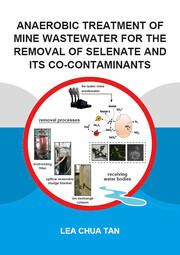
1st Edition
Anaerobic Treatment of Mine Wastewater for the Removal of Selenate and its Co-Contaminants
Chapter 1 - General Introduction
1.1 Background
1.2 Problem description
1.3 Research objectives
1.4 Structure of the thesis
1.5 References
Chapter 2 - Selenium: Environmental significance, pollution, and biological treatment technologies
Abstract
2.1 Introduction
2.2 Why is selenium important?
2.3 Selenium-laden wastewaters
2.4 Biotreatment technologies
2.5 Challenges in selenium biotechnologies
2.6 Future perspective in selenium biotechnologies
2.7 Conclusions
2.8 References
Chapter 3 - Effect of elevated nitrate and sulfate concentrations on selenate removal by mesophilic anaerobic granular bed reactors
Abstract
3.1 Introduction
3.2 Materials and methods
3.3 Results
3.4 Discussion
3.5 Conclusions
3.6 References
Chapter 4 - Selenate removal in biofilm systems: effect of nitrate and sulfate on selenium removal efficiency, biofilm structure, and microbial community
Abstract
4.1 Introduction
4.2 Materials and methods
4.3 Results
4.4 Discussion
4.5 Conclusions
4.6 References
Chapter 5 - Biological treatment of selenium-laden wastewater containing nitrate and sulfate in an upflow anaerobic sludge bed reactor at pH 5.0
Abstract
5.1 Introduction
5.2 Materials and methods
5.3 Results
5.4 Discussion
5.5 Conclusions
5.6 References
Chapter 6 - Comparative performance of anaerobic attached biofilm and granular sludge reactors for the treatment of model mine drainage wastewater containing selenate, sulfate and nickel
Abstract
6.1 Introduction
6.2 Materials and methods
6.3 Results
6.4 Discussion
6.5 Conclusions
6.6 References
Chapter 7 - Amberlite® IRA-900 ion exchange resin for the sorption of selenate and sulfate: Equilibrium, kinetic and regeneration studies
Abstract
7.1 Introduction
7.2 Material and methods
7.3 Results
7.4 Discussion
7.5 Conclusions
7.6 References
Chapter 8 - Simultaneous removal of sulfate and selenate from wastewater by process integration of an ion exchange column and upflow anaerobic sludge blanket bioreactor
Abstract
8.1 Introduction
8.2 Materials and methods
8.3 Results
8.4 Discussions
8.5 Conclusions
8.6 References
Chapter 9 - General discussion and future perspective
9.1 General discussion
9.2 Future perspectives
9.3 Conclusions
9.4 References
Appendices
Appendix 1
Supporting information for Chapter 3
Appendix 2
Supporting information for Chapter 4
Appendix 3
Supporting information for Chapter 5
Appendix 4
Supporting information for Chapter 6
Appendix 5
Supporting information for Chapter 7
Appendix 6
Supporting information for Chapter 8
Appendix 7
Microbial community analysis
Biography
Lea Chua Tan was born in 1987 in Manila, Philippines. She obtained her bachelor in science (BSc) in Chemical Engineering from De La Salle University - Manila, and earned her Chemical Engineering License in 2009. Lea worked in the industry until 2012 as a Wastewater Engineer Supervisor at Ibiden Philippines Inc., as a Field Service Coordinator at Emerson Electric Asia Ltd. Rosemount Analytical Division and as a Research Assistant at the Center for Sustainable Development (CeSDR) in De La Salle University - Manila. She earned her master in science (MSc) degree in Environmental Engineering from Hokkaido University in 2014, where she worked on the biological-based response evaluation of different reclamation systems using a combination of conventional bioassay and transcriptome-based analysis as test battery. Lea started a PhD Fellow at UNESCO-IHE, Delft, the Netherlands in 2014, focussing on understanding the biological anaerobic treatment process for mine wastewater for the removal of selenate and its co-contaminants. She successfully earned her PhD on the 18th December 2017, and is currently working as a post-doctoral researcher at National University of Ireland, Galway focusing on anaerobic digestion.
