




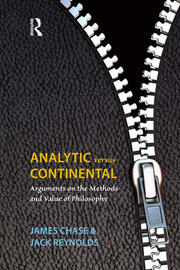

1st Edition
Analytic Versus Continental Arguments on the Methods and Value of Philosophy
Biography
James Chase is Lecturer in Philosophy at the University of Tasmania, Australia.
Jack Reynolds is Associate Professor in Philosophy at La Trobe University, Australia.
"This book takes the reader on an impressively informed and well-argued trip through the personalities, the methodologies, and the ways of thinking and writing, that divide analytic from continental philosophers. Anyone who seeks to understand why adherents of the two traditions so often misunderstand each other, not always in friendly ways, should read this book." - Frank Jackson, Princeton University, USA
"This is the most comprehensive and balanced account of the analytic and continental divide. It combines a detailed account of its historical roots with a bipartisan yet acute analysis of its current state" - James Williams, University of Dundee, UK
"This book gives a superb overview of the full range of discussions, arguments, positions and main figures in continental and analytic philosophy, and it provides invaluable insight into the myriad methodological, topical and doctrinal differences between the two traditions. Essential reading for anyone interested in understanding the divide that has shaped philosophy for the past century." - Søren Overgaard, University of Copenhagen, Denmark
"This book succeeds where others fail: it engages and informs both analytic and continental philosophers and so encourages a rapprochement that may well revitalize the broader discipline. Most highly recommended." - C. G. Prado, Queen's University, Canada
