




1st Edition
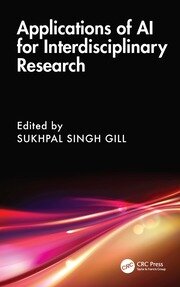
Applications of AI for Interdisciplinary Research
Part I Healthcare
Chapter 1 ◾ Machine Learning-Based Prediction of Thyroid Disease
Tanjina Rhaman and Sukhpal Singh Gill
Chapter 2 ◾ HeartGuard: A Deep Learning Approach for Cardiovascular Risk Assessment Using Biomedical Indicators Using Cloud Computing
Parinaz Banifatemi and Sukhpal Singh Gill
Chapter 3 ◾ Deep Convolutional Neural Networks-Based Skin Lesion Classification for Cancer Prediction
Neelam Rathore and Sukhpal Singh Gill
Chapter 4 ◾ Explainable AI for Cancer Prediction: A Model Analysis
Aswin Kumar Govindan and Sukhpal Singh Gill
Chapter 5 ◾ Machine Learning-Based Web Application for Breast Cancer Prediction
Shabnam Manjuri and Sukhpal Singh Gill
Part II Natural Language Programming (NLP)
Chapter 6 ◾ Machine Learning-Based Opinion Mining and Visualization of News RSS Feeds for Efficient Information Gain
Jairaj Patil and Sukhpal Singh Gill
Part III Economics and Finance
Chapter 7 ◾ Advanced Machine Learning Models for Real Estate Price Prediction
Satyam Sharma and Sukhpal Singh Gill
Chapter 8 ◾ Stock Market Price Prediction: A Hybrid LSTM and Sequential Self-Attention-Based Approach
Karan Pardeshi, Sukhpal Singh Gill, and Ahmed M. Abdelmoniem
Chapter 9 ◾ Federated Learning for the Predicting Household Financial Expenditure
Ho Kuen Lai, Ahmed M. Abdelmoniem, and Sukhpal Singh Gill
Part IV Computing and Business
Chapter 10 ◾ Deep Neural Network-Based Prediction of Breast Cancer Using Cloud Computing
Sindhu Muthumanickam and Sukhpal Singh Gill
Chapter 11 ◾ Performance Analysis of Machine Learning Models for Data Visualisation in SME: Google Cloud vs. AWS Cloud
Jisma Choudhury and Sukhpal Singh Gill
Part V Security and Edge/Cloud Computing
Chapter 12 ◾ Enhancing Data Security for Cloud Service Providers Using AI
Muhammed Golec, Sai Siddharth Ponugoti, and Sukhpal Singh Gill
Chapter 13 ◾ Centralised and Decentralised Fraud Detection Approaches in Federated Learning: A Performance Analysis
Shai Lynch, Ahmed M. Abdelmoniem, and Sukhpal Singh Gill
Contents ◾ vii
Chapter 14 ◾ AI-Based Edge Node Protection for Optimizing Security in Edge Computing
Muhammed Golec, Waleed Ul Hassan, and Sukhpal Singh Gill
Part VI Telecom Sector and Network
Chapter 15 ◾ Predictive Analytics for Optical Interconnection Network Performance Optimisation in Telecom Sector
Suganya Senguttuvan and Sukhpal Singh Gill
Part VII Emotional Intelligence
Chapter 16 ◾ Machine Learning-Based Emotional State Inference Using Mobile Sensing
Diogo Mota, Usman Naeem, and Sukhpal Singh Gill
Part VIII Internet of Things (IoT) and Mobile Applications
Chapter 17 ◾ Social Event Tracking System with Real-Time Data Using Machine Learning
Muhammad Usman Nazir and Sukhpal Singh Gill
Biography
Dr. Sukhpal Singh Gill (FHEA) is a Assistant Professor in Cloud Computing at School of Electronic Engineering and Computer Science (EECS), Queen Mary University of London (QMUL), UK and he is a member of Network Research Group. Prior to this, Dr. Gill has held positions as a Research Associate at Evolving Distributed Systems Lab at the School of Computing and Communications, Lancaster University, UK and also as a Postdoctoral Research Fellow at the Cloud Computing and Distributed Systems (CLOUDS) Laboratory, School of Computing and Information Systems, The University of Melbourne, Australia. He has published his PGCAP/PGCert work in highly-ranked Education Conferences and Journals. Before joining CLOUDS Lab, Dr. Gill worked in the Computer Science and Engineering Department of Thapar University, India, as a Lecturer. Dr. Gill received a Doctoral Degree specialization in Autonomic Cloud Computing from Thapar University. He worked as a Senior Research Fellow (Professional) on DST Project, Government of India. Dr. Gill was a research visitor at Monash University, University of Manitoba, University of Manchester and Imperial College London. He has recieved several awards. He has also served as the PC member for various venues. He has co-authored 150+ peer-reviewed papers and has published in prominent international journals and conferences. He serves as a Guest Editor and is a regular reviewer for multiple journals. He has also edited multiple research books He has also written for magazines such as Ars Technica, Tech Monitor, Cutter Consortium and ICT Academy. For further information, visit www.ssgill.me.
"In RNA: Computational Methods for Structure, Kinetics, and Rational Design, Professor Peter Clote offers a comprehensive and insightful exploration into the intricate world of RNA, combining the realms of biology, mathematics, and computational science with finesse. This book is the beautiful outcome of Clote's profound expertise in the field, presenting a treasure trove of knowledge that will undoubtedly captivate both novices and seasoned researchers alike.
What sets this book apart is its seamless integration of theoretical principles with practical applications, making complex concepts accessible to readers from diverse backgrounds. Clote's lucid explanations, coupled with illustrative examples and meticulously curated exercises, empower readers to navigate the intricate landscape of RNA research with confidence.
Throughout the book, Clote's passion for his subject matter shines through, infusing each page with enthusiasm and intellectual curiosity. Whether you are a student delving into the fundamentals of RNA or a seasoned researcher seeking to push the boundaries of knowledge, this book is an indispensable companion on your scientific journey.
In summary, RNA: Computational Methods for Structure, Kinetics, and Rational Design is a tour de force that deserves a place on the bookshelf of every scientist, educator, and enthusiast interested in the fascinating world of RNA. With its unparalleled depth, clarity, and visionary insights, this book not only informs but also inspires, leaving an indelible mark on the landscape of computational biology."
--Dr. Henri Orland, Institute of Theoretical Physics (IPhT), Paris-Saclay University, CNRS, CEA, France
