





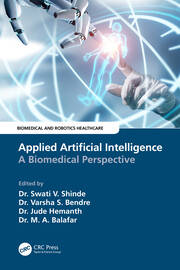
1st Edition
Applied Artificial Intelligence A Biomedical Perspective
PART I Applied Artificial Intelligence for Biomedical Applications
Chapter 1 Healthcare Fees-Centric to Value-Centric Transformation through Data, Analytics, and Artificial Intelligence
Sanjeev Manchanda and Mahesh Kshirsagar
Chapter 2 AI-Based Healthcare: Top Businesses and Technologies
Dipali Ghatge and K. Rajeswari
Chapter 3 Insights into AI, Machine Learning, and Deep Learning
Aditya Shinde and Swati Shinde
PART II Medical Image Processing Using Deep Learning Algorithms
Chapter 4 Deep Learning for Visual Perceptual Brain Decoding as Image Classification
Saumya Kushwaha, Priyanka Jain, and N. K. Jain
Chapter 5 Automatic Brain Tumor Segmentation in Multimodal MRI Images Using Deep Learning
Seyyed-Mahdi Banan-Khojasteh and Mohammad-Ali Balafar
Chapter 6 Automated Prediction of Lung Cancer Using Deep Learning Algorithms
S. Das, P. Kumar, S. Pal, and S. Majumder
Chapter 7 Cervical Cancer Screening Approach Using AI
D. Santhi, M. Carmel Sobia, and M. Jayalakshmi
Chapter 8 Progression Detection of Multiple Sclerosis in Brain MRI Images
Santosh Chede and Surekha Washimkar
Chapter 9 Artificial Intelligence Clustering Techniques on Dermoscopic Skin Lesion Images
V. Saravana Kumar, M. Kavitha, S. Anantha Sivaprakasam, E. R. Naganathan, Sunil Bhutada, K. G. Suma, Lakshmi Priya, and M. Kavitha
Chapter 10 Automated Alzheimer’s Disease Detection with Optimized Fuzzy Neural Network
Preeti Topannavar, Dr. D. M. Yadav, and Dr. Varsha Bendre
Chapter 11 A Comprehensive Survey with Bibliometric Analysis on Recent Research Opportunities of Multimodal Medical Image Fusion in Various Applications
Manjiri A Ranjanikar, Nilam Upasani, Asmita Manna, Jaishri M. Waghmare, Shimpy Goyal, Rachana Y. Patil, and Bharati P. Vasgi
PART III Medical IOT and Recent Trends
Chapter 12 Big Data in IoT for Healthcare Application
Nilam Upasani, Deepali Joshi, Sanika Upasani, and Swayam Pendgaonkar
Chapter 13 Automatic Detection of Diabetic Retinopathy to Avoid Blindness
Smita Das, Sushanta Das, Saptarshi Debray, Madhusudhan Mishra, and Swanirbhar Majumder
Chapter 14 A Review on Wireless BAN to Measure the Respiration Rate Using SoC Architecture
H. R. Archana, H. H. Surendra, A. P. Jyothi, S. Lalitha, and K. N. Madhusudhan
PART IV Biomedical Signal Processing
Chapter 15 Deep Feature Extraction for EEG Signal Classification in Motor Imagery Tasks
Rashmi S and Vani Ashok
Chapter 16 Effect of Age in Normal Women by Heart Rate Variability Analysis
Anjali C. Birajdar and Vijaya R. Thool
Chapter 17 EEG Signal Analysis Using Machine Learning and Artificial Intelligence for Identification of Brain Dysfunction
Rajeswari Aghoram and S. B. Athira
PART V Recent Trends in Biomedical Applications
Chapter 18 Cervical Cancer Screening Methods: Comprehensive Survey
Swati Shinde, Madhura Kalbhor, and Aditya Shinde
Chapter 19 Understanding Assessment Methods and Sensors for ADHD Hyperactive-Impulsive Type among Children
T. Kumar and M. B. Malarvili
Chapter 20 Security of Medical Image Information by Cryptography and Watermarking Using Python
Pallavi R. Waghmare and Jaishri M. Waghmare
Chapter 21 Integration of Biosensors and Drug Delivery Systems for Biomedical Applications
Jithu Jerin James and Sandhya K. V.
Chapter 22 Automatic Liver and Lesion Segmentation in CT Using 3-D Context Convolutional Neural Network: 3-D Context U-Net
Lida Daryani Ghazani and M. A. Balafar
Index
Biography
Dr. Swati V. Shinde has a Ph.D. in Computer Science and Engineering, from Swami Ramanand Teerth Marathwada University, Nanded. She has 20 years of teaching experience and is currently working as a Professor at Pimpri Chinchwad College of Engineering (PCCoE), Pune. She has worked as a HOD-IT for seven years in PCCoE. Her research interests include Machine Learning, Deep Learning, Soft Computing, Artificial Neural Network, and Fuzzy Logic.
Dr. Varsha Bendre received a Bachelor’s degree in Electronics and Telecommunication Engineering from Saint Gadge Baba Amravati University, Amravati, and M.E degree from Savitribai Phule Pune University in 2000 and 2010 respectively. She completed a Ph.D. in the area of Nanotechnology and Low Power VLSI from Savitribai Phule Pune University, Pune, and Maharashtra, India in Jan 2020. Her research work is focused on analog circuit design at very deep submicron technology using Carbon Nanotube Field-Effect Transistors.
Dr. D. Jude Hemanth received his B.E degree in ECE from Bharathiar University in 2002, M.E degree in communication systems from Anna University in 2006, and Ph.D. from Karunya University in 2013. His research areas include Computational Intelligence and Image processing.
Dr. MA Balafar completed his Ph.D. in IT from UPM, Malaysia. He has 16 years of teaching experience and is working as an Assistant Professor at the University of Tabriz, Iran. His research interests are AI, computer vision, Fuzzy Logic, Deep Learning, Machine Learning, and information security.
