




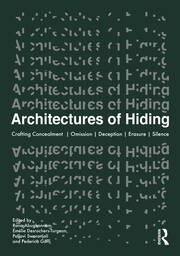

1st Edition
Architectures of Hiding Crafting Concealment | Omission | Deception | Erasure | Silence
Part 1: Modes of Hiding: Veiled Devices Beyond the Gaze
Interlude 1: Verdures: Mimicry and Camouflage
François Sabourin and Bertrand Rougier
Interviewed by Ryan Stec and Pallavi Swaranjali
1. Camouflage After the Bauhaus: Oskar Schlemmer, László Moholy-Nagy and György Kepes
Jodi La Coe and Marcia Feuerstein
2. Walls and Hidden Forms of Walling: The Production of Spatial Violence in Beirut
Jenan Ghazal
3. Hiding, Veiling and Transversing: Nubian Madyafa Post-Displacement
Menna Agha
4. From Concealed Caves to Dis(Cover)ed Bunkers: Gaetano Pesce’s Pre-/Post-Historical Atomic Shelter
Kyveli Mavrokordopoulou
5. Concealed Behind Transparencies: A Closer Look at Architecture’s Hidden Performativity Through the Barcelona Pavilion
Ramon Rispoli
6. Happy Schools: The Visible and Invisible in the Sven Lokrantz School and the Architecture of Special Education
Dora Vanette
Interlude 2: Deformative, Yet Silent
Samira Daneshvar
Interviewed by Pallavi Swaranjali
Part 2: Motives of Hiding: Disguised Narratives
Interlude 3: Avert
Heather Leier
Interviewed by Ryan Stec and Pallavi Swaranjali
7. Hiding in Plain Sight: The White House Solarium and the Projection of History
Eliyahu Keller
8. Urban Alibi and Its Terms of Concealment: Cases From Shanghai
Ying Zhou
9. Hiding Behind Colonial Roots: Investigating the Reconstruction of the Palestinian Presidential Headquarters (the Muqata’a) in Ramallah
Anwar Jaber
10. [Hidden Architecture]: The Paracontextual in Superstudio’s Project of Instrumentalizable Muteness
Ashley Mason
11. Architects’ Hidden Building Signatures
Paul Emmons
12. Clutter, Tidying and Architectural Desires
Rebecca Williamson
Interlude 4: Hidden Relics
Claudio Sgarbi
Interviewed by Ryan Stec and Pallavi Swaranjali
Part 3: Concealed Apparatus: Latencies and Potentialities in Material Realities
Interlude 5: Yellow + Blue: An Apparatus for Fabricating Illusionary Architecture
Zenovia Toloudi
Interviewed by Pallavi Swaranjali
13. Hiding in the Wings: A Culture of the Onlooker in Eighteenth-Century France
Louise Pelletier
14. Principles of Masking: Wall Paintings by Thomas Schütte and Ludger Gerdes, Circa 1977
Stefaan Vervoort
15. Concealment, Costume and Modern Architecture
Teminioluwa Thomas
16. Architecture, Infrastructure and Occlusion in Miami: The Network Access Point of the Americas
Jeffrey Kruth and Allison Schifani
17. Drawn Lines Conceal Multitudes: The Hidden Traces of Time in Carlo Scarpa’s Drawn Factures for the Brion Memorial
Kristin Washco
18. Impossible Gag: Clues to a Hidden Reality in Winsor McCay’s and Buster Keaton’s Representations of Dreams
Linda Heinrich
Interlude 6: A New Approach to Hidden History: The Reconstruction of History Through Nodal Spaces in the Ghost City of Lifta
Hala Barakat
Interviewed by Ryan Stec and Pallavi Swaranjali
Coda: The Architecture of Hiddenness: Latency and Virtuality in the Topology of Concealment
Don Kunze
Biography
Rana Abughannam is assistant professor at the School of Architecture and Landscape Architecture, University of British Columbia. She taught at Carleton University, the Canadian University Dubai and Birzeit University. She is a registered architect in Palestine with a degree in architectural engineering (Birzeit University) and a master of history and theory of architecture (McGill University). Her doctoral research (Carleton University) focuses on counter-colonial practices in Palestine.
Émèlie Desrochers-Turgeon is assistant professor at the Dalhousie University School of Architecture. Her research areas include the relationship between built environments and grounds through material fictions, architectural representation, extractive infrastructures and liquid landscapes. Educated professionally in architecture (McGill University) and environmental design (UQAM), she practiced design in Canada and Germany before pursuing her PhD in architecture at Carleton University.
Pallavi Swaranjali is program coordinator and professor in the Bachelor of Interior Design program, Algonquin College, Ottawa. She holds a PhD in architecture (Azrieli School of Architecture and Urbanism, Carleton University), a BA in architecture and an MDesign in industrial design from India, where she also practiced. She is an intern architect with the Ontario Association of Architects. Her research centers on architecture and storytelling.
Federica Goffi is professor of architecture, and co-chair of the architecture PhD Program at the Azrieli School of Architecture and Urbanism at Carleton University, Canada. She published on architectural representation and the role of time in architecture. She holds a PhD in architecture and design research (Virginia Tech), a Dottore in Architettura (University of Genoa), and is a licensed architect in her native country, Italy.
"This volume performs a masterful reveal of architecture’s masked motives and methods. Its elegant structure presents remarkably rich and diverse insights into architecture’s invisible agencies."
Leslie Van Duzer, Professor of Architecture, University of British Columbia
"The editors have assembled a wide-ranging cast of scholars to account for the unaccounted. Aggregating terms with a family resemblance to the gerund 'hiding' – from camouflage to clutter, violence to veils – the authors discuss how buildings and builders actively occlude their own political, physical, and cultural orders. Interested in post-truth history and criticism of the built world? Then this is a book for you."
David Theodore, Associate Professor, McGill University
“At a time of greater enforcement of data protection principles for the personal information of individuals, this invaluable book delves into an essential topic: understanding the dynamics, the imaginative possibilities, the moral dilemmas and ethical responsibilities of concealment and revealment in architecture, its histories, theories, power structures and overlooked narratives.”
Sophia Psarra, Professor of Architecture and Spatial Design, Bartlett School of Architecture, UCL
