





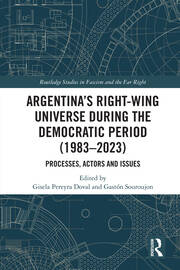
1st Edition
Argentina’s Right-Wing Universe During the Democratic Period (1983–2023) Processes, Actors and Issues
Introduction: The Kaleidoscope of Argentine Right-Wing Politics
Gastón Souroujon and Gisela Pereyra Doval
1. Cold War, Peronism and Anti-Communism in Argentina (1943-1983)
Ernesto Bohoslavsky and Marina Franco
2. The Configuration of the Right-Wing World During the Last Civic-Military Dictatorship in Argentina
Paula Canelo
3. Political Right-Wing and Democracy
Sergio Morresi
4. When Peronism Met the New Right. The Menem Administration (1989-1999): Between Neoliberalism and Neopopulism
Gastón Souroujon
5. Everything Solid Vanishes in the Air: The Rise to Power of Cambiemos in Argentina
Dario Rodriguez
6. Democracy, Authoritarianism and Conservative Power in Provincial Territories: Asynchronies, Tensions and Articulations in a Federal State
Cecilia Lesgart and Celeste Schnyder
7. Republic and Right-Wing Politics in Argentina. Republican Traditions and Democracy: from UCEDÉ to PRO
Gabriela Rodríguez Rial
8. Conceptual Configuration of the Rights in the Role of the Armed Forces during Argentina’s Democracy: Oscillations, Connections and Challenges
Andrea Bolcatto
9. Right-Wing Political Parties in Argentina (1983–2022)
Juan Bautista Lucca and Marcos Pérez Talia
10. Gaining Light From the Shadows. Economic Elites and the Right-Wing in Argentina in the Last Democratic Era
Alejandro Pelfini, Gabriel Levita and Luis Miguel Donatello
11. The Constitution of Right-Wing Collective Action Repertoire in Democratic Argentina
Esteban Iglesias
12. Forking Paths? Right-Wing Intellectuals After the Democratic Restoration
Martín Vicente and Boris Matías Grinchpun
13. The Catholic World in the Face of Democracy
Luis Miguel Donatello
14. Modulations of the Right-Wing Faced to Feminism: Reactions, Nuances and Discursive Radicalisation
Mariana Berdondini and Lucia Vinuesa
15. A “Right-Wing” Media System? Structure, Concentration and Polarisation in Argentine Media Between 1983 and 2020
Martín Becerra and Natalí Schejtman
16. “Change Is to the Right”. Youth Participation and “New Right-Wing Formations” in the 2018–2021 Cycle
Melina Vázquez
17. Of Patriots and Globalists: The Right’s Influence on Argentina-United States Relations
Federico Merke and Gisela Pereyra Doval
18. Views on Latin American Regionalism and Argentine Insertion in the Regional Landscape: A Typology of the Argentine Political Right
María Victoria Alvarez and Sergio Caballero
19. Argentina's New Right-Wing and Bilateral Regional Ties: Building an External Agenda in a Debate Between Ideas and Pragmatism
Natalia Ceppi and María Elena Lorenzini
Epilogue: Right-Wing Actors, Ideas and Historical Conditions in the Democratization Waves in Argentina and the Southern Cone. A Comparative Perspective
Verónica Giordano
Biography
Gisela Pereyra Doval is a researcher at Argentina’s National Scientific Research Council (CONICET) and Assistant Professor in International Relations Problematic at National University of Rosario (UNR), Argentina.
Gastón Souroujon is a researcher at Argentina’s National Scientific Research Council (CONICET) and Assistant Professor in Classical and Contemporary Political Theory at National University of Rosario (UNR) and National University of Litoral (UNL), Argentina.
'The study of right-wing politics has largely been ignored in Latin America in the twenty first century, as the region was defined by, and focused on, the pink tide of left populism. But as the fourth wave of the far right has washed ashore, it is crucial that journalists and scholars do not only look at similar movement abroad but also study the recent past of the domestic right-wing. This excellent edited volume on the right-wing in Argentina connects the past and present, stability and transformation, and national and regional developments. A blueprint for studies in other countries in the region!'
Cas Mudde, University of Georgia, USA
'The book, assembling a wide ranging group of contributors, addresses a subject outside the conventional range of studies on modern Argentina and Latin America, one likely to become increasingly salient during the current era of conservative populism.'
David Rock, University of Cambridge, UK
'This is the first comprehensive book on the evolution of the Argentine right since 1983, in all its sectors and complexity. Including historical background and approaches ranging from political science, political philosophy, intellectual history, and gender and cultural studies, this timely and fascinating book provides an indispensable road map for understanding the shifts and transformations within the right in this country, as well as how international events and currents have affected it.'
Sandra McGee Deutsch, University of Texas, USA
'This book is, truly, everything you always wanted to know about the right in Argentina —politically, ideologically, institutionally, and historically— particularly since the return to democracy. It shows how, in so many different fields, two broad traditions of the right, both at odds with popular rule through most of the twentieth century, transformed themselves in a kaleidoscopic way (and in interaction with international trends), adapting to electoral politics. The various manifestations of the right are examined both in opposition and in power, either with Menem’s Peronist government or Macri’s anti-Peronist government. The contributions, analyzing political parties, social actors, and foreign relations, together constitute a clear must read for anyone with interest in Argentine politics and society.'
Pierre Ostiguy, University of Valparaíso, Chile
'This is an important book on a country that has posed a puzzle for many decades. The editors have gathered an impressive array of contributors from a range of disciplines. Their analysis offers an exhaustive and fascinating exploration of how various European ideologies, ideas and doctrines came to be adopted and adjusted to the local context in Argentina to inform political action and government policy. In the process, they provide a wide range of insights that supply some clues as to ‘what went wrong’ in Argentina and why.'
Hans-Georg Betz, University of Zurich, Switzerland
