




1st Edition
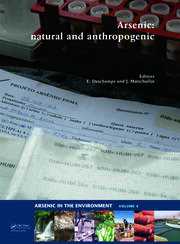
Arsenic: Natural and Anthropogenic
Obituary for Wolfgang Höll (†)
Section I: Arsenic in the environment, toxicology and remediation
- The global arsenic cycle revisited (Jörg Matschullat)
- Motivation and challenges
- The global biogeochemical arsenic cycle
- Arsenic toxicology – A review (Eduardo de Capitani)
- Toxicology
- Toxicokinetics
- Clinical manifestations
- Arsenic removal from water (Wolfgang Höll (†), Eleonora Deschamps)
- Introduction
- Arsenic removal by precipitation
- Arsenic removal through sorption
- Arsenic elimination through coagulation / filtration
- Arsenic elimination by membrane processes
- Technology options for arsenic removal and immobilization (Eleonora Deschamps)
- Introduction
- Arsenic removal technologies
- Overriding factors in technology selection
- EPA Comparative study to choose the best technology
- Final considerations
- Environmental laws and regulations (R. Vieira, S. Oberdá, N. Rocha)
- Introduction
- The Brazilian situation
- History and socioeconomy – Iron Quadrangle (I. Menses, F.E. Renger, E. Deschamps)
- A brief history of the Iron Quadrangle
- Socioeconomy – Nova Lima and Santa Bárbara districts
- Physical aspects of the Iron Quadrangle (Katiane Almeida, Jörg Matschullat, Jaime Mello, Isabel Meneses, Zenilde Viola)
- Geology – Geomorphology
- Soils of the Iron Quadrangle
- Climate and Hydrology
- Project philosophy, history and development (E. Deschamps, J. Matschullat)
- Environmental and health perceptions (Adriano Tostes, E. Deschamps)
- Objectives
- Methodology
- Discussion and analysis of results and products
- Conclusions
- Dust sampling and interpretation (Jörg Matschullat)
- Sampling (total, wet, dry, and interception deposition)
- Biomonitoring with lichens
- Aerosols
- Domestic dusts
- Surface water (O. Vasconselos, S. Oberdá, E. Deschamps, J. Matschullat)
- Sampling, sample preparation and analysis
- Results and interpretation
- Soils and sediments (Eleonora Deschamps, Jaime Mello, Jörg Matschullat)
- Sampling of soils and sediments
- Preparation and analytical methods
- Soil and sediment results, health risk assessment
- Arsenic – geochemistry and environmental mobility
- Arsenic in edible and bioaccumulating plants (O. Vascconcelos, H. Palmieri, J. Matschullat, E. Deschamps)
- Arsenic uptake in plants
- Sampling, sample preparation and analysis
- Arsenic in edible plants and ferns – Iron Quadrangle
- Consequences of arsenic in edible plants
- Human biomonitoring (Nilton Couto, Silvânia Mattos, Jörg Matschullat)
- Introduction
- Sampling, storage, and analytical procedures
- Results and interpretation
- Health issues and conclusions
- Environmental and health education (S. Oberdá, E. Deschamps, L. Fittipaldi)
- Environmental education
- Environmental education and healthcare workshops
- Workshop details
- Workshop evaluation
- Water treatment – a local example (Eleonora Deschamps, Neila Assunção)
- Introduction
- Technical details of the treatment plant
- Start-up and performance control
- Mitigation and solutions (Eleonora Deschamps, Jörg Matschullat)
- Risk evaluation
- Institutional measures
- Recommendations
Section II: Iron Quadrangle, ARSENEX project and related perceptions
Section III: From air, water and soil to the human body
Section IV: Solutions and outlook – meeting the challenges
Section V: Annex
Subject index
Biography
Jörg Matschullat graduated as Geologist (B.Sc.) from the Technical University of Clausthal, received his Masters Degree (Dipl. Geol.) from the University of Tübingen, and Dr. rer. nat. in geology and geochemistry from the University of Göttingen. He performed Post-Doctorates at the universities of Clausthal and Heidelberg, Germany. As of 1999, Jörg is full professor of geochemistry and geoecology at the Technical University Bergakademie Freiberg, Director of its Interdisciplinary Environmental Research Centre (IÖZ), and Dean of the Faculty of Geosciences, Geoengineering and Mining of TU Bergakademie Freiberg. his areas of interest are: atmospheric and climate science, environmental geochemistry and earth system science.
Eleonora Deschamps graduated as Chemical Engineer (B.Sc.) from the Federal University of Minas Gerais (UFMG) in Belo Horizonte, Brazil and received an Engineering Degree (Dipl.-Ing./M.Sc.) from the Rheinisch-Westfälische Technische Hochschule (RWTH) in Aachen, Germany. She received her Doctoral Degree (PhD) in metallurgic engineering from the College of Engineering at UFMG. Today, Eleonora is professor at the FUMEC University Center of Environmental Engineering, and works as manager of the Division for Industrial Solid Waste at the FEAM Department for Industrial processes and Environmental Analysis, Belo Horizonte. Her areas of competence are: ore treatment, environmental geochemistry, controlled waste disposal, licencing and control of mining activities and chemical industry.
"Without a doubt, this book is a prime example for environmental assessment of Arsenic contamination where natural processes and anthropogenic activities interfere with each other. The concepts and methods presented here are not restricted to the Brazilian environment but can be transferred also to other regions of the globe as well as to other pollutants. The book provides environmental scientists, technicians and planners with an excellent example on how to design and conduct interdisciplinary studies on environmental pollution and how to draw sensible conclusions from their findings."
—S. Norra, Institute of Geography and Geoecology, Karlsruhe Institute of Technology, Germany, in Environmental Earth Sciences (2011) 63
