




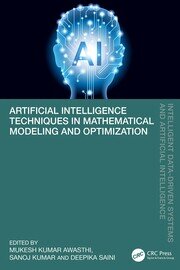
1st Edition
Artificial Intelligence Techniques in Mathematical Modeling and Optimization
Chapter 01: Introduction to AI-Driven Mathematical Modelling
Mukesh Kumar Awasthi, Sanoj Kumar, Deepika Saini
Chapter 02: Machine Learning Fundamentals for Optimization
Sandeep Kumar Mogh, Vikas Jangid, Muskan Ara, Aman Kumar Singh
Chapter 03: Data Pre-processing and Feature Engineering for Optimization
Suvojit Dhara
Chapter 04: Deep Learning Techniques: From Training to Generalization
Manoj K. Singh, Sanoj Kumar, Deepika Saini
Chapter 05: Neural Network in Mathematical Modeling
Aman Kumar Singh, Sandeep Kumar Mogha
Chapter 06: Multi-Objective Optimization Using AI
Gouranga Duari, Basu Dev Shivahare, Maheshwari Niranjan
Chapter 07: Fire Hawk Optimization Plus (FHO+): An Advanced Swarm Intelligence Technique
Yash Gupta, Sameer Sethi, Kinshuk Kumar, Parisha Khurana, Ankur Gupta
Chapter 08: Quantum Optimization: Bridging Classical and Quantum Paradigms
Aman Kanshotia, Kirankumar R. Hiremath, Md Abu Talhamainuddin Ansary
Chapter 9: Optimised Quantum CNN for Fashion MNIST Classification
Sahil, Kirankumar R. Hiremath, Gaurav Bhatnagar
Chapter 10: Maximum Power Extraction from Wind Energy Conversion System Based on Artificial Intelligence
Apoorva Srivastava, R.S. Bajpai
Chapter 11: An Ensemble Framework for Cyclone Detection Using Satellite and Interpolated Images
Nikita Yadav, Pushpendra Kumar
Chapter 12: Smoke Detection through Motion-Aware Attention-Driven DenseNet Architecture
Nitish Kumar Mahala, Pushpendra Kumar
Chapter 13: Heartsight: A Computational Intelligence Framework for Early Detection of Heart Disease
Rajashree Dash, Sai Prasad Biswal
Chapter 14: An Explainable AI (XAI) and Machine Learning Approach for Detecting Postpartum Suicidal Tendencies in Women
Chandra Mani Sharma
Chapter 15: Multi-Objective Inventory Optimization Considering Circular Economy Principles
Anil Dhanda, Mehak Sharma, Mandeep Mittal
Chapter 16: Future Trends and Emerging Technologies in AI Optimization
Sanoj Kumar, Mukesh Kumar Awasthi, Deepika Saini
Biography
Mukesh Kumar Awasthi has done his Ph.D. on the topic “Viscous Correction for the Potential Flow Analysis of Capillary and Kelvin-Helmholtz instability”. He is working as an Assistant Professor in the Department of Mathematics at Babasaheb Bhimrao Ambedkar University, Lucknow. Dr. Awasthi is specialized in the mathematical modeling of flow problems. He has taught courses of Fluid Mechanics, Discrete Mathematics, Partial differential equations, Abstract Algebra, Mathematical Methods, and Measure theory to postgraduate students. He has acquired excellent knowledge in the mathematical modeling of flow problems and he can solve these problems analytically as well as numerically. He has a good grasp of the subjects like viscous potential flow, electro-hydrodynamics, magneto-hydrodynamics, heat, and mass transfer. He has excellent communication skills and leadership qualities. He is self-motivated and responds to suggestions in a more convincing manner. Dr. Awasthi has qualified National Eligibility Test (NET) conducted on all India level in the year 2008 by the Council of Scientific and Industrial Research (CSIR) and got Junior Research Fellowship (JRF) and Senior Research Fellowship (SRF) for doing research. He has published 135 plus research publications (journal articles/books/book chapters/conference articles) in national and international journals and conferences. Also, he has published 19 books. He is also a series editor of Artificial Intelligence and Machine Learning for Intelligent Engineering Systems published by CRC Press. He has attended many symposia, workshops, and conferences in mathematics as well as fluid mechanics. He has got the “Research Awards” consecutively four times from 2013-2016 by the University of Petroleum and Energy Studies, Dehradun, India. He has also received the start-up research fund for his project “Nonlinear study of the interface in multilayer fluid system” from UGC, New Delhi. He is also listed among the top 2% of influential researchers in the world, as prepared by Stanford University based on Scopus data for the years 2022 and 2023. His Orcid is 0000-0002-6706-5226, Google Scholar web link is https://scholar.google.co.in/citations?user=Dj3ktGAAAAAJ and research gate web link ishttps://www.researchgate.net/profile/Mukesh-Awasthi-2.
Sanoj Kumar works as an assistant professor (SG) at Data Science Cluster, SOCS, UPES, Dehradun, Uttarakhand, India. Earlier, he worked as a postdoctoral fellow with the Department of Mathematics and Computer Science, University of Udine, Italy, from October 2013 to September 2014. He completed his PhD in mathematics from IIT Roorkee, India, in 2013. Dr. Kumar's research interests include image processing, computer vision, and machine learning. He has authored more than 25 papers published in referred international journals and conferences. He has also authored two book chapters. He is a reviewer for various journals such as ISA Transactions, IET Image Processing, Optical Engineering, Applied Mathematical Modeling, Mathematics, etc. He also got the best paper and young scientist awards in NETCRYPT 2020. His teaching area includes Engineering Mathematics I, Engineering Mathematics II, discrete mathematics, graph theory, optimization techniques, numerical analysis, linear algebra, probability and statistics, real analysis, complex analysis, differential equation, digital image processing and introduction to data science, etc.
Deepika Saini is an assistant professor at Graphic Era (deemed to be) University, Dehradun, Uttarakhand, India. Previously, in 2016, she received her Ph.D. in Mathematics from IIT Roorkee in India. She completed her M.Sc. in Mathematics from H.N.B. Garhwal University, Srinagar, Uttarakhand, India. She won the gold medal for securing first place among all PG students in her M.Sc. in 2005. Dr. Saini's research interests include computer vision, image processing, computer graphics, and their applications in various branches of engineering. She has published more than 20 papers in various international journals and reputed conferences. She has also authored a book chapter. She also got the best paper award in NETCRYPT 2020. Her teaching area includes Mathematics I, Mathematics II, Mathematics III, discrete mathematics, computer based numerical and statistics techniques, linear programming, numerical analysis, linear algebra, algebra, differential equation etc.
