




1st Edition
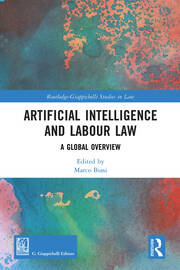
Artificial Intelligence and Labour Law A Global Overview
Introduction
Marco Biasi
Part I: AI and Labour Law: Mapping the Core Issues
- AI at work, algorithmic bosses, and the ambivalence of automation
Antonio Aloisi and Valerio De Stefano - Sharing responsibilities along the AI lifecycle: Towards a responsible labour AI regulatory regime
Einat Albin - The bright side of AI for work: From (unbrindled) risk to (regulated) opportunity
Marco Biasi - Artificial Intelligence and health and safety at work: The regulation of emotion recognition technologies
Stefania Marassi - The rise of algorithmic surveillance: Legal and ethical implications for the future of work
Marta Otto - Artificial Intelligence and equality at work
Alysia Blackham - Artificial Intelligence and remote work
Chiara Cristofolini - Robotization and humanization
Simon Taes - AI and digital labour platforms
Christina Hießl - AI, work, and virtual worlds
David Mangan - A collective rights framework for regulating AI at work
Silvia Rainone - Artificial Intelligence in European social security administration: Regulatory frameworks and implications
Alberto Barrio Fernández - Compliance and enforcement of workers' rights in the age of AI
Giovanni Gaudio - Predictive justice and threats to human rights in labour law disputes
Carlotta Manz and Marco Giacalone
Part II: Country Analysis - Governing workplace AI: Normative tensions between the AI Act and labour law
Miriam Kullmann - Artificial Intelligence and labour law in Spain
Adrián Todolí-Signes - Artificial Intelligence and labour law in France
Sophie Sereno - Labour law and AI in Italy: Between old regulations and new rules
Emanuele Dagnino - The right to know algorithms: Trade unions and Poland's first AI workplace regulation
Piotr Grzebyk - The arbitrariness of the AI-boss: A Republican critique of UK labour law
Philippa Collins - The divided states of work law: Regulating US workplaces in the age of AI
Alvin Velazquez and Charlotte Garden - Labour law and Artificial Intelligence in Chile
Sergio Gamonal C. - Regulation, Artificial Intelligence and the world of work: analysing Brazilian initiatives
Olívia De Quintana Figueiredo Pasqualeto - Integrating Artificial Intelligence into Australian labour law
Gabrielle Golding - AI and labour law regulation in Israel
Edo Eshet - The price for ignoring AI regulation: Russian experience in labour law matters
Denis Novikov and Elena Sychenko - Artificial Intelligence and labor law in China: Scenarios, rules, and prospects
Yan Tian - Artificial Intelligence and labour law in Japan: Challenges and prospects
Masahito Toki
Concluding remarks
Marco Biasi
Biography
Marco Biasi is an Associate Professor of Labour Law at the Law Department “Ce-sare Beccaria” of the University of Milan, Italy, where he is the head of the courses of “Artificial Intelligence and Labour Law” and of “Comparative Labour Law”. He was a Visiting Scholar at the Law School of Stanford University in 2022 and at the ILR School of Cornell University in 2015. During his PhD years at Bocconi Uni-versity in Milan, he was a Visiting PhD Candidate at University of Jena in 2012. Professor Biasi has authored three books, edited nine volumes and published sev-eral articles both in Italian and in English. His main research fields are: labour law and technology; labour law and artificial intelligence; remedies and sanctions in employment law; dismissal protection policies; employee involvement in the man-agement of companies; work regulation in the sports industry.
