




1st Edition
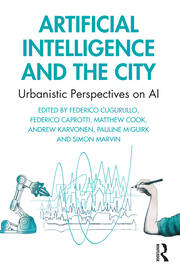
Artificial Intelligence and the City Urbanistic Perspectives on AI
Chapter 1: Introducing AI into Urban Studies
Federico Cugurullo, Federico Caprotti, Matthew Cook, Andrew Karvonen, Pauline McGuirk and Simon Marvin
Section 1 – Autonomous Vehicles and Mobility
Chapter 2: Reinforcing and Refracting Automobility: Urban Experimentation with Autonomous Vehicles
Robyn Dowling, Pauline McGuirk and Alistair Sisson
Chapter 3: Trials and Tribulations: Who Learns What from Urban Experiments with Self-driving Vehicles?
Jack Stilgoe and Cian O'Donovan
Chapter 4: Autonomous Lorries, Artificial Intelligence and Urban (Freight) Mobilities
Debbie Hopkins
Chapter 5: An Urbanistic Take on Autonomous Vehicles
Federico Cugurullo and Eva Kassens-Noor
Chapter 6: A Roadmap for the Sustainable Deployment of Autonomous Vehicles: Superblocks Driving Cars out of Neighbourhoods
Elisabetta Vitale Brovarone and Luca Staricco
Section 2 – Urban Robots and Robotic Spaces
Chapter 7: Regulating and Making Space for the Expanded Field of Urban Robotics
Aidan While
Chapter 8: Everyday Droning: Uneven Experiences of Drone-enabled AI Urbanism
Anna Jackman
Chapter 9: Exploring Temporal Pleats and Folds: the Role of Urban AI and Robotics in Reinvigorating the Cyborg City
Miguel Valdez, Matthew Cook and Stephen Potter
Chapter 10: Robots in AI Urbanism
Shanti Sumartojo
Chapter 11: Airport Robots: Automation, Everyday Life and the Futures of Urbanism
Weiqiang Lin and Sie Je Ivin Yeo
Section 3 – City Brains and Urban Platforms
Chapter 12: Ambient Commons? Valuing Urban Public Spaces in an Era of AI-Enabled Ambient Computing
Sarah Barns
Chapter 13: Encountering Limits in Cooperative Platforms: the More-Than-Technical Labour of Urban AI
Adam Moore and David Bissell
Chapter 14: Performed Imaginaries of the AI-Controlled City: Conducting Urban AI Experimentation in China
Bei Chen
Chapter 15: Optimizing the Immeasurable: on the Techno-Ethical Limits of Predictive Policing
Aaron Shapiro
Chapter 16: Chinese Artificial Intelligence Governance Platforms 2.0: the Belt and Road Edition
Alan Smart, Yawei Zhao and Dean Curran
Section 4 – Urban Software Agents and Algorithms
Chapter 17: Perceptions of Intelligence in Urban AI and the Contingent Logics of Real Estate Estimate Algorithms
Casey R. Lynch and Vincent J. Del Casino Jr.
Chapter 18: Caring is Connecting: AI Digital Assistants and the Surveillance of Elderly and Disabled Family Members in the Home
Miriam E. Sweeney
Chapter 19: AI Doctors or AI for Doctors? Augmenting Urban Healthcare Services Through Artificial Intelligence
Zongtian Guo and Federico Cugurullo
Chapter 20: Algorithms and Racial Discrimination in the U.S. Housing Market
Eva Rosen and Philip Garboden
Chapter 21: Architectural AI: Urban Artificial Intelligence in Architecture and Design
Davide Pisu and Silvio Carta
Chapter 22: Conclusions: The Present of Urban AI and the Future of Cities Federico Cugurullo, Federico Caprotti, Matthew Cook, Andrew Karvonen, Pauline McGuirk and Simon Marvin
Biography
Federico Cugurullo is Assistant Professor in Smart and Sustainable Urbanism at Trinity College Dublin.
Federico Caprotti is Professor of Human Geography at the University of Exeter, UK..
Matthew Cook is Professor of Innovation at the Open University, UK.
Andrew Karvonenis Professor of Urban Design and Planning at Lund University, Sweden.
Pauline McGuirk is Senior Professor in Urban Geography at the University of Wollongong, Australia.
Simon Marvin is Professor of Urban Geography at the University of Sheffield's Urban Institute, UK.
"One of the great puzzles of modernity involves the way new technologies change the very systems that spawn them. Artificial Intelligence and the City brings together a diverse array of ideas that show how digital developments from autonomous vehicles, drones and robots to platform economies and predictive policing, are changing the way we behave and the regulations we are inventing to contain them. This is the first book to provide an integrated picture of the new landscape of urban artificial intelligences, one that we will all need to navigate on the road to the future. Essential reading for all who are attempting to understand the critical challenges of AI."
Michael Batty, Bartlett Professor of Planning, University College London
"The advent of generative AI and deep learning algorithms has undercut and transcended the concept and technical practice of the so-called smart city. With Artificial Intelligence and the City the shift from smart ontologies to AI logics of the urban is explored across multiple case studies, from urban drones to autonomous vehicles in the city. A timely and important intervention."
Louise Amoore, Professor of Political Geography, Durham University.
"Artificial intelligence is transforming the socio-technical characteristics of cities under late modernity. This vital collection of essays presents multiple vantage points from which to reflect on emerging articulations between AI and urban space."
Matthew Gandy, Professor of Geography, University of Cambridge.
"By departing from the polemic that typifies explorations of artificial intelligences, this book is a well-structured and thoughtfully curated volume on the interrelationships between AI and cities. This welcome departure from smart urbanism explores the textures of urban AI at varying scales and geographic contexts, and offers the reader many stories of caution and hope by exploring, not only how the city is influenced by autonomous vehicles, robotics, platforms and algorithms, but also how it reframes and reorders these socio-technical relations."
Nancy Odendaal, Professor in City Planning, University of Cape Town
"This timely book provides a comprehensive and thought-provoking analysis of urban AI, examining in detail the workings and implications of autonomous vehicles, robotics, and AI-enabled platforms and services for city life. Richly illustrated with case studies, it is an essential guide to our emerging sentient cities."
Rob Kitchin, Professor of Human Geography, Maynooth University
"In this fantastic contribution to the field of Urban AI, the authors outline the plethora of issues pertaining to the era of urban artificial intelligence that is now upon us. They present the many ways in which AI and robotics have entered into urban spaces while reminding the reader that such techno-urban symbiosis is not new, and thus deserves careful consideration for the short and long term implications on the fabric of the city. For any reader interested in (sustainable) AI and the future of cities, this book is sure to open one's eyes to the many ways in which cities have become experimental testing sites for AI with implications for those living in cities, for the structure of the city, and for the future of AI."
Aimee van Wynsberghe, Alexander von Humboldt Professor of Applied Ethics for AI, University of Bonn
