




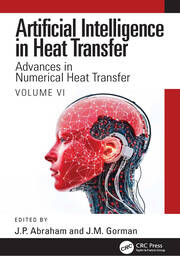
1st Edition
Artificial Intelligence in Heat Transfer Advances in Numerical Heat Transfer Volume VI
1. Physics-informed neural networks for solving partial differential equations.
Prakhar Sharma, Michelle Tindall, and Perumal Nithiarasu
2. Multi-Objective Optimization of Heat Transfer Problems.
Andrea Fragnito, Marcello Iasiello, Gerardo Maria Mauro, Wilson K.S. Chiu, and Nicola Bianco
3. CFD/HT Simulations and DNN Modelling of Conjugate Heat Transfer in Metal Foams.
Ubade Kemerli, Muhsin Gokhan Gunay, and Yogendra Joshi
4. Integrating Artificial Intelligence in Nanofluid Heat Transfer: A Deep Dive into Artificial Intelligence Applications.
Andaç Batur Çolak
5. Developing an Artificial Neural Network Algorithm for Heat and Mass Transfer Assessment in Ternary Hybrid Nanofluid Flow.
Shilpa B. and Naveen Kumar
6. Physics Informed Deep Learning Approaches for Industrial Heat Exchangers.
Vishal Jadhav, Ritam Majumdar, Anirudh Deodhar, Shirish Karande, Lovekesh Vig, and Venkataramana Runkana
7. AI based Analysis for Optimizing Radiative Jeffery-Hamel Flow for Cross-Diffusion Effects: A Physics Informed Machine Learning.
Muhammad Naeem Aslam, Nadeem Shaukat, and Arshad Riaz
8. Machine Learning Process on Double Diffusive Convection in a Parallelogram Shaped Cavity.
Bengisen Pekmen and Hakan F. Oztop
Biography
J.P. Abraham is a professor of thermal sciences at the University of St. Thomas School of Engineering, Minnesota, and the current editor-in-chief of Numerical Heat Transfer. His area of research includes thermodynamics, heat transfer, fluid flow, numerical simulation, and energy. After gaining his doctorate at the University of Minnesota in 2002, he joined St. Thomas as an adjunct instructor, later becoming a full-time faculty member. He has produced over 400 publications, books, book chapters, conference presentations, and patents in areas including biological heat transfer and fluid flow, biomedical device design, energy, burn injuries, climate change, fundamental heat transfer and fluid mechanics, and manufacturing processes.
J.M. Gorman is currently an independent consultant in the mechanical engineering field. In addition to teaching as an adjunct professor, he is also a part of several startup companies ranging from biomedical, automotive, and novel heat recovery systems. After receiving his doctorate at the University of Minnesota in 2014, he was a research associate at the University of Minnesota until 2020. His research encompasses all facets of mechanical engineering, and his teaching is focused on modeling and numerical simulation in the thermal sciences. He has published over 60 papers in archival journals, along with five book chapters. He has also been a serial editor of Advances in Heat Transfer and the Advances in Numerical Heat Transfer book series.
