




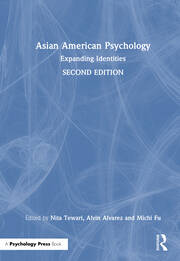
2nd Edition
Asian American Psychology Expanding Identities
PART I: FOUNDATION AND ROOTS OF ASIAN AMERICAN PSYCHOLOGY
1: Asian Americans: An Overview of History, Diversity, Complexity and Resiliency
Matthew Mock
2: History of Asian American Psychology
Frederick T. L. Leong, Yutong (Ritornia) Zheng, Xizhi Liu and Nita Tewari
3: Research Methods
Linda Toch, Anne Saw and Sumie Okazaki
4: Model Minority Myth: Rethinking the Concept
Andrew Young Choi
PART II: BALANCING MULTIPLE WORLDS
5: Acculturation and Enculturation: Theory, Research & Practice
Bryan Kim, Han Na Suj and Eunseon Gong
6: Asian American Racial and Ethnic Identity
Tai Chang and Karl Kwan
7: Religion and Spirituality
Daniel D. Lee, Kin Cheung George Lee, and Kavita Pallod Sekhsaria
8: Colonialism: Societal and Psychological Impacts on Asian Americans and Pacific Islanders,
Kevin Nadal, Sheharyar Hussain and Kristina Arevalo
9: Intersectionality and APIDA Communities
Marcia Liu
PART III: GENDER AND INTIMATE RELATIONSHIPS
10: Asian American Women: The Price of Invisibility, Obligation, and Beauty
Michi Fu, Weiying (Lucky) Chen, Donna Hajhamid and Kai Basler-Chang
11: Asian American Men, Masculinity, and Asianized Attribution: Intersections of Masculinity, Race, and Sexuality
Jennifer Youna Jang, Derek Kenji Iwamoto, and William Ming Liu
12: Queer and Trans ANHPI Communities: History, Research, and Action
Saumya Arora and Anneliese Singh
13. "We Don’t Talk About That": Influence, Stigma and Advocacy in APIDA Sexuality
Michi Fu, Arpine Markosyan and Liliana Garcia
14: Relationships in the Asian American Community: Dating, Partnerships, and Arranged Marriage
Muninder Alhuwalia, Anjali Badrinath, Lisa Suzuki, and Haruka Kokaze
15: Asian American and Pacific Islander Families
Lisa Liu, Shu-wen Wang, Heejung Park and Joey Fung
PART IV: NEXT GENERATION
16: Parenting: Bridging Families Through Conversation and Empathy
Alexandra Thurston and Diane Hayashino
17: Adopted Asian Americans: Culture Migration and Race
Oh Myo Kim, Adam King Marisa Huang and Richard M. Lee
18: Parachute Kids
Teresa Mok
19: Multiracial Asian Americans: Historical and Theoretical Frameworks for Identity and Mental Health
Haejin Jang and Annabelle L. Atkin
PART V: SOCIAL AND LIFE ISSUES
20: Racism: “It Isn’t Fair”
Alvin Alvarez and Leslie Jaeyoun Shin
21: APIDA Media: From the Margins to the Mainstream
Jeffrey Scott Mio, Michi Fu, Michelle Sugihara and Raphael Solano
22: Psychological Considerations for Evolving Asian American Career Lifespan Development,
Susana M. Lowe
23: Stress, Trauma, and Refugee Resilience
Pa Her and Nancy N. Truong
24: Advocacy and Policy Change for Asian American Communities
Anne Saw, Sherry C. Wang, Grace A. Chen, and Manjusha P. Kulkarni
PART VI: HEALTH AND WELL-BEING
25: Physical Health and Wellness
Shamin Ladhani, Shin Ye Kim and Patrina Wong
26: Psychopathology and Clinical Issues with Asian Pacific Islander and Desi American Populations
Duyen Tran, Carmel S. Saad, Sabrina Misra, and Oanh L. Meyer
27: Body Image Among Asian Americans
Aimee C. Chan, Kathleen Y. Kawamura, and Thomas P. Le
28. Asian Americans and Addictions
Alice W. Cheng and Jennifer F. Hsia
29: Indigenous Healing
Donna Demanrig and Marilisa Raju
30: Cultural Compass: Guiding Mental Health Services for Asian Pacific Islander and Desi Americans
Amy La and Sherwin Imperio
Biography
Nita Tewari is a licensed psychologist and the Founder and CEO of SITARA Psychology Center, a mental health practice specializing in providing therapy services, psychological support and leadership coaching to young adults, women and professionals. She is also the author of Counseling and Psychotherapy for South Asian Americans (Routledge, 2023)
Alvin A. Alvarez is currently Professor of counseling and Associate Dean of the College of Health and Social Sciences at San Francisco State University, USA.
Michu Fu is Professor of Clinical Psychology at Alliant International University, USA. They graduated with an emphasis in Multicultural Community Clinical Psychology (MCCP) and they are also Visiting Professor of National Taiwan University.
Remarkably, Asian American Psychology: Expanding Identities, 2nd Edition not only meets the high standard set by its predecessor—it surpasses it. Written by leading scholars, experts, and practitioners in Asian American psychology, each chapter offers cutting-edge insights and perspectives, integrating theoretical, conceptual, and real‑world applications across a wide range of topics…This second edition is poised to become the new gold standard in the field. Rich, comprehensive, and urgently relevant, it is a goldmine of knowledge at a time when such understanding is critically needed.
~ Derald Wing Sue PhD, Columbia University, USA.
Addressing “Asian American psychology” is always an ambitious endeavor, because it requires simultaneously recognizing the vast heterogeneity of the Asian diaspora in the United States, and the tender balancing act of exploring complex colonization and migration histories and intersectionalities. Asian American Psychology: Expanding Identities elegantly consolidates the expertise of diverse scholars to address contemporary developmental, systemic, interpersonal, and intrapersonal issues in these understudied subgroups and populations. This book is an essential and comprehensive resource for students, researchers, and clinicians seeking a nuanced and grounded exploration of the myriad acculturative, psychological and psychosocial considerations faced by the range of Asian communities in the United States.
~ Ramani Durvasula PhD, New York Times Bestselling Author.
Asian American Psychology: Expanding Identities is a foundational distillation of decades of expertise on bimodal, intersectional APIDA communities. Outstanding researchers and clinical experts in APIDA mental health have deftly woven historical context, psychological research, and heritage wisdom into timely and accessible chapters. The uncolonized, action-oriented chapters integrating social determinants of health and their relevance to psychopathology risk factors can be a resource and guide in health promotion and community empowerment. This is an essential volume for all readers seeking in depth knowledge of Asian American Psychology. Reading this felt like engaging in a masterclass with top Asian American Psychology mentors.
~ Helen H. Hsu PsyD, Stanford University, USA.
Asian American perspectives and experiences can significantly inform American and global conversations on colonialism, immigration, racism, trauma, Indigeneity, well-being, and many other topics and issues. This makes Asian American Psychology: Expanding Identities especially relevant, timely, and critical. Drs. Nita Tiwari, Alvin Alvarez, and Michi Fu have done an outstanding job of assembling a group of scholars, service providers, and community leaders who not only provide coverage and discussion of these issues that are based on rigorous science and scholarship, but are also grounded in the realities of the communities they represent. This book is a must-have and a must-read!
~ E. J. R. David PhD - University of Alaska Anchorage, USA.
