





1st Edition
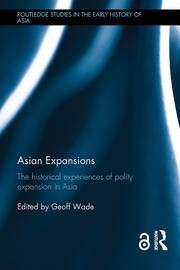
Asian Expansions The Historical Experiences of Polity Expansion in Asia
1. Asian Expansions: an Introduction, Geoff Wade 2. Why Do Empires Expand?, Peter C. Perdue 3. Asian States and Overseas Expansion, 1500–1700: An Approach to the Problem of European Exceptionalism, Tonio Andrade 4. The "Native Office" System – A Chinese Mechanism for Southern Territorial Expansion over Two Millennia, Geoff Wade 5. The Southeast Asian Mainland and the World Beyond: Rethinking Assumptions, Victor Lieberman 6. The Thirteenth Province: Internal Administration and External Expansion in Fifteenth Century Đại Việt, John K. Whitmore 7. The Vietnamese Empire and its Expansion 980-1840, Momoki Shiro 8. Siamese State Expansion in the Thonburi and Early Bangkok Periods, Koizumi Junko 9. Politics of Integration and Cultures of Resistance: A Study of Burma’s Conquest and Administration of Arakan, Jacques P. Leider 10. Re-evaluating State, Society and the Dynamics of Expansion in Precolonial Gowa, William Cummings
Biography
Geoff Wade is a Visiting Fellow at the Crawford School of Public Policy, College of Asia and the Pacific, Australian National University.
"Asian Expansions, a collection of ten articles, explores the motivations, processes, and dynamics of expansion of Asian states and empires from 1400 to 1900. Examining the case of China and four Southeast-Asian countries (Vietnam, Burma, Thailand, Indonesia, to use the modern names), the articles collectively ask how Asian states or emprires expanded their territorial domain, equipped with a relatively coherent culture from 1400 to 1900 despite the kaleidoscopic ethnic, cultural, and political diversity prevalent in proevious centuries."
—Kwangmin Kim, University of Colorado, Boulder
