




1st Edition
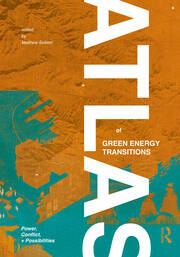
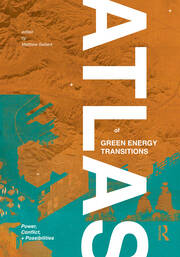
Atlas of Green Energy Transitions Power, Conflict, and Possibilities
Introduction: The Dark Side of Green
Matthew Seibert
1. Sun: Solar Farms and a Mojave Desert Under Threat
Kelly Herbinson
2. Wind: Wind Power and Deepening Conflicts in Biobío, Chile
Javier Arroyo Olea and María Paz López Ponce
3. Aluminum: Smelting with Iceland's Melting Glaciers
Theodore Teichman and Daniel Carmelo
4. Photovoltaics: Unpacking the Waste Chalenges of a Global Industry
Assia Boukhatmi and Roger Nyffenegger
5. E-Waste: Reclaiming the Digital Detritus, Forging a Sustainable Dawn in Zimbabwe
Vusumuzi Maphosa
6. Hydrogen: Landscape and Literacy along Canada's Peace River
Douglas Robb
7. Rare Earths: Extractive Frontiers of Green Capitalism in South Greenland
Billy Fleming
8. Lithium: White Gold and Black Geographies of Resistance in Brazil
Fitsum Areguy
9. Cobalt: Eating Congo Caviar at the End of the World
Ash Duhrkoop
Conclusion: Where Histories are Held and Futures Rehearsed
Matthew Seibert and Hugo Kamya
Center the Periphery: or, How to Invert a Mine
Matthew Seibert and Julia MacNelly
Circularize the Economy: Designing for Disassembly
Matthew Seibert and Julia MacNelly
Overlap Systems: Searching for Symbiosis
Matthew Seibert and Julia MacNelly
Reduce Energy, Build Community: The Cultural Project of a True Transition
Matthew Seibert and Julia MacNelly
Author Bios
Index
Biography
Matthew Seibert’s work aspires to encourage one to rethink their position and relation to the world as the first, fundamental step in a theory of change toward a just, more promising future.
As an Associate Professor of Landscape Architecture at the University of Virginia, his research and teaching challenge dominant modes of knowledge production with specific attention to land relations. This practice and pedagogy in support of a world where many worlds and worldviews are not only welcome, but desired, is built first by creatively interrogating conventional ways of knowing through strategic disorientation. In the design of novel tools and methods, presuppositions can be disassembled, cultural constructions confronted, and power structures dismanteld, enabling a radical rebuilding of self, community, and environment in new and powerful ways. One must look backward and inward to orient the march forward.
"This is important work. Atlas of Green Energy Transitions will leave you with a deep grasp of the hidden costs behind the promises of tech solutionism. In the face of humanity’s all-life-threatening problems, what was supposed to be a 'green' transition ends up perpetuating 500 years of colonial extractivism. It’s a powerful and beautifully illustrated book full of tools you can use to counter the narratives driving forward what was supposed to be progress."
Céline Keller, artist activist
"The growing 'green economy' of solar panels, windmills, and lithium batteries implies new supplies of copper, nickel, cobalt, rare earths, and other materials. It also implies new forms of land grabbing and water grabbing. This empirical book goes fearlessly around the world looking at grassroots complaints against the abuses of the energy transition. The industrial economy is not circular, it is entropic. There is an enormous 'circularity gap' or 'metabolic rift', an 'entropy hole' because less than ten percent of the materials entering the economy are recycled. Can this be amended? This book provides realistic answers."
Joan Martinez-Alier, ICTA Universitat Autónoma de Barcelona
"Everybody is talking about an energy transition. But we rarely see where this transition is actually unfolding—or what it is leaving behind. This is precisely why Mathew Seibert’s Atlas is so profoundly necessary. With a creative and highly engaging format, the authors of this volume guide us through the landscapes of extraction and exploitation that fuel our anything-but-clean energy transition. A must-read for anyone seeking a radical alternative to the tired, recycled promises of 'green' development."
Marco Armiero, ICREA Research Professor at the UAB and editor-in-chief of Resistance. A Journal of Radical Environmental Humanities
"An informative and much needed challenge to modern design’s complicity in capitalism and its conceptions of progress and development. Seibert’s Atlas offers compelling resources for rethinking our reliance on ecomodernist approaches to green energy transition, and directs us towards a future more open to alternative ways of providing for human flourishing and prosperity"
Kate Soper, Emeritus Professor of Philosophy, London Metropolitan University
"In engrossing first-person accounts of the far-flung locales where green capitalism collides with local ecosystems, landscapes, and communities—and interspersed with stunning data visualizations, creative cartography, and photographs of field sites—this atlas vividly depicts, critiques, and reimagines the extractive frontiers of green technologies and renewable energy. An essential resource for scholars, students, and organizers alike."
Thea Riofrancos, Associate Professor of Political Science, Providence College, author of Extraction: The Frontiers of Green Capitalism
"Matthew Seibert’s Atlas draws a much-needed pathway out of green energy utopianism by taking readers into those landscapes and their attendant ecologies that have been conscripted into the green energy supply chain. It’s an ambitious proposition backed by richly layered maps, embodied collages, charts, narratives, counternarratives, and a diverse suite of contributors. Both persistently disruptive and optimistic, the book crosses continents to illustrate the scope, scale, and urgency of what has all too easily been framed as simply a 'transition.' Still, the book dares to visualize a just, beautiful, and reciprocal green future with clear, tactical framings of our next steps. I dare readers to do the same."
Kristi Cheramie, Professor and Head of Landscape Architecture, Ohio State University
