




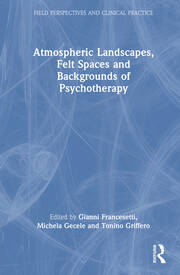
1st Edition
Atmospheric Landscapes Felt Spaces and Backgrounds of Psychotherapy
Introduction
Gianni Francesetti, Michela Gecele, Tonino Griffero
1. Where Does Well-Being Hide? Felt-Bodily Resonance
Tonino Griffero
2. The Individual as Psychopathology. Journey into the Indeterminate to Reconstruct a Presence
Michela Gecele
3. The Unseen “Seen”, the Unheard “Heard” — Atmospheres and the Contact-boundary
Dan Bloom
4. The Re-instatement of the Vague
Frank Staemmler
5. Being Called. How Atmospheres Touch and Move Us
Olaf Zielke
6. Atmosphere: Towards a Phenomenological Understanding of the Development of Intersubjectivity
Francisco Mujica, Benedikte Kudahl, Tone Roald
7. Cinematic Atmospheres
Giovanna Silvestri, Michela Gecele
8. Atmospheres: Affective Ecologies of Psychotherapy
Enara Garcìa
9. Narrating and Narrated Atmospheres, in Literature and Psychotherapy
Michela Gecele, Anne Duvivier, Francesco Alfieri
10. The Many Letters of the Alphabet of Body-awareness
Georg Pernter
11. Covid-19 and the Shift in Deontological Feeling: Atmospheric Effects of Pandemic Policies and Their Impact on Common Sense
Henning Nörenberg
12. Pieve Tesino 2021-2024
Maria J. Romero, Robert Mauksch
Biography
Gianni Francesetti is a psychiatrist, Gestalt psychotherapist, and Adjunct Professor at the Department of Psychology, University of Turin (Italy).
Michela Gecele is a psychiatrist and Gestalt psychotherapist. She previously coordinated a psychological and psychiatric service for immigrants in Turin.
Tonino Griffero is full Professor of Aesthetics (Tor Vergata, Rome), editor of book series (Sensibilia, Atmospheric Spaces) and the e-journal Lebenswelt.
'As Gestalt therapy continues to evolve, an exciting center of theoretical and methodological development has emerged in Italy, influenced by the work of Gianni Francesetti, MD, and Michela Gecele, MD, who co-edited this volume with Professor Tonino Griffero. With its focus on atmospheres, this book brings together leading Gestalt therapy voices offering reflections across many areas of interest, including psychotherapy, theater, psychiatric emergency, fiction, child development, and beyond. This consideration of atmospheres broadens the Gestalt therapist’s way of being and attending, providing new modes of understanding and new avenues of connection. I highly recommend this important volume.'
- Peter Cole, LCSW, Sierra Institute for Contemporary Gestalt Therapy; Berkeley, California USA
'The introduction alone is worth the price of this book! A rich, clear, humane discourse on therapy that will lift your sights and hearts, and cannot help but enrich your capacities as a therapist and a fellow human.'
- Lynne Jacobs, PhD, Dir. Pacific Gestalt Institute, Los Angeles
‘It is with great enthusiasm and a profound sense of academic responsibility that I offer this formal recommendation for the forthcoming publication, “Atmospheric Landscapes: Felt Spaces Between Life and Clinical Practice”, edited by Gianni Francesetti, Michela Gecele, and Tonino Griffero. This volume represents an main achievement in contemporary European thought, successfully bridging the traditionally disparate fields of neo-phenomenological philosophy and clinical psychotherapy.
The primary merit of this project lies in its radical re-conceptualization of the “atmosphere”. While the study of atmospheres has long been a staple of aesthetic and architectural theory, this book moves the discourse into the vital arena of human suffering and therapeutic intervention. By defining atmospheres as “spatial feelings” and “affective ecologies”, the work shifts the focus from an individualistic, “introjectivist” psychopathology toward a field-based perspective.
This shift is not merely semantic; it is a profound ontological redirection. The book argues that the “contact-boundary” is not just where two subjects meet, but a pre-personal, affective place that precedes subjectivity itself. Such an approach offers a potent alternative to the rigid subject-object dualisms that have often constrained the mental health sciences.
The intellectual weight of this volume is sustained by a diverse and world-class roster of contributors. The editorial team itself is a testament to the project’s caliber: Tonino Griffero, a leading figure in neo-phenomenological atmospherology, provides the foundational philosophical rigor. Gianni Francesetti and Michela Gecele bring their unparalleled expertise in Gestalt therapy and psychopathology, ensuring that the theory remains grounded in “felt-bodily resonance”.
The collection further benefits from the insights of renowned scholars such as Thomas Fuchs, who explores the crossmodal perception of atmospheres in the digital age, and Dan Bloom, who revitalizes the aesthetic and poetic roots of clinical presence. The inclusion of voices from various disciplines—from literature and cinema to sociology and neurobiology—creates a polyphonic dialogue that is as broad as it is deep.
This volume is a quintessential example of the vitality of European thought. It draws upon a rich lineage—including Husserl, Merleau-Ponty, Schmitz, and Bion—to address modern crises. Its relevance is particularly striking in its application to contemporary phenomena:
Societal Shifts: Analyzing the “deontological shift” and impact on common sense following the Covid-19 pandemic.
Technological Evolution: Critically examining the “vibe” of online psychotherapy and the challenges of establishing rapport in virtual spaces.
Specific Pathologies: Offering revolutionary lenses for understanding autism.
In summary, “Atmospheric Landscapes” is more than a textbook; it is a manifesto for a more “pathic”, embodied, and relational understanding of the human condition. It reinstates the importance of “the vague” and the “indeterminate” in a world increasingly obsessed with clinical objectivity.
I have no doubt that this work will become a seminal reference point for philosophers, clinicians, and scholars of “ambiance” across the continent and beyond. It is a work of immense intellectual courage that reminds us that “there is nothing so practical as a good theory.’
- Bruce Bégout, directeur de SPH, Professeur des universités Philosophie-phénoménologie, Université Bordeaux-Montaigne
