





1st Edition
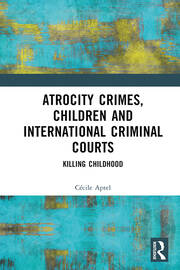
Atrocity Crimes, Children and International Criminal Courts Killing Childhood
Table of Contents
1. Introduction
1.1. International accountability for atrocity crimes
1.1.1. International and hybrid criminal courts
1.1.2. International or atrocity crimes
1.2. Defining a child
1.3. How international crimes affect children
1.4. Arguments and structure
2. The legal protection of children under international law
2.1. International human rights law
2.1.1. The human rights of children
2.1.2. Child rights
2.2. International humanitarian law
2.2.1. IHL treaties
2.2.2. Customary IHL
2.3. The prohibition of the recruitment and use of children in hostilities
2.4. The protection of children recruited or used in hostilities
2.5. Procedural Guarantees
2.5.1. Protection of children during investigations
2.5.2. Protection in court
2.5.3. Participation of child-victims in the proceedings
3. International Courts and Child Specific Crimes
3.1. Forcible transfer of children to another group
3.1.1. The Genocide Convention
3.1.2. Forcible transfers of children by Nazi Germany
3.1.3. The International Criminal Tribunals for the former Yugoslavia and Rwanda *
3.1.4. The International Criminal Court
3.2. Conscripting or enlisting children or using them to participate actively in hostilities
3.2.1. The International Military Tribunal of Nuremberg
3.2.2. The Special Court for Sierra Leone
3.2.3. The International Criminal Court
3.2.4. Salient jurisprudential findings
3.3. Attacks against buildings dedicated to education
4. International Courts and Children Victims of Generic Atrocity Crimes
4.1. The International Military Tribunal of Nuremberg
4.1.1. Crimes against children as part of the civilian population
4.1.2. Crimes against Jewish children
4.1.3. Nazi indoctrination and mobilization of youth
4.2. The International Military Tribunal for the Far East
4.2.1. Indoctrination
4.2.2. Crimes against non-Japanese children in occupied territories
4.2.3. Sexual crimes
4.3. The International Criminal Tribunal for the former Yugoslavia
4.3.1. Killing of boys
4.3.2. Sexual crimes
4.4. The International Criminal Tribunal for Rwanda
4.4.1. Children victims of genocide
4.4.2. Sexual crimes
4.5. The Special Court for Sierra Leone
4.5.1. Additional crimes against ‘child-soldiers’
4.5.2. Sexual crimes
4.5.3. Forced marriage *
4.5.4. Crimes against other children
4.6. The International Criminal Court
4.6.1. Lubanga
4.6.2. Katanga
4.6.3. Ntaganda
5. International Courts and Children involved in international crimes
5.1. Minimum age of criminal responsibility and juvenile justice
5.1.1. Juvenile justice
5.1.2. Minimum age of criminal responsibility
5.2. International criminal jurisdictions and children involved in crimes
5.2.1. The International Military Tribunals of Nuremberg and Tokyo *
5.2.2. The International Criminal Tribunal for the former Yugoslavia
5.2.3. The International Criminal Tribunal for Rwanda
5.2.4. Mixed or ‘hybrid’ courts
5.2.5. The International Criminal Court
5.3. Children involved in crimes as witnesses before international courts
5.4. What is in the best interest of the children involved in crimes?
5.5. Children involved in crimes and transitional justice
6. Conclusion
6.1. International criminal courts and children: accomplishments and failures
6.1.1. The International Military Tribunal of Nuremberg
6.1.2. The International Military Tribunal of Tokyo
6.1.3. The International Criminal Tribunal for the former Yugoslavia
6.1.4. The International Criminal Tribunal for Rwanda *
6.1.5. The Special Court for Sierra Leone
6.1.6. East Timor Special Panels Panels for Serious Crimes
6.1.7. The International Criminal Court
6.2. Explaining these accomplishments and failures
6.2.1. External circumstances
6.2.2. Surmounting internal obstacles
6.3. An agenda for improvement
6.3.1. Child friendly procedures
6.3.2. Beyond child-soldiers: a broader scope
6.3.3. Rethinking the international investigative and prosecutorial strategies
Bibliography
Biography
Dr Cécile Aptel is an international legal practitioner recognised for her expertise in international criminal justice, international humanitarian law, human rights and child rights. She has over 20 years of experience in international affairs, working for several UN entities, think-tanks and NGOs, at headquarters and in Africa, the Middle East and the Balkans. She currently is the deputy director of UNIDIR, a UN think-tank on disarmament and security, and was until 2019, director and acting under-secretary general at the International Federation of the Red Cross and Red Crescent. Previously, she led the creation of the UN Mechanism on Syria and contributed to establishing the Special Tribunal for Lebanon, the Court of Bosnia-Herzegovina and, earlier, the UN international tribunals for the former Yugoslavia and Rwanda. She is professor of practice at the Fletcher School, Tufts University, visiting scientist at Harvard University and visiting professor at the Geneva Graduate Institute and Geneva Academy.
“This book gives voice to the voiceless: children who are victims of international crimes such as genocide, crimes against humanity and war crimes. Dr. Cécile Aptel, an experienced international lawyer and child rights expert, shows how children are neglected in international trials as victims and witnesses… She calls on practitioners and activists to depart from ‘an adult-centric understanding of international crimes’. Children’s ‘specific rights, perspectives and needs’, Dr. Aptel reminds us, cannot simply be ‘subsumed under those of adults’.”
Tianying Song, Journal of Peace Research Atrocity Crimes, Children and International Criminal Courts: Killing Childhood Routledge – Peace Research Institute Oslo (PRIO)
