




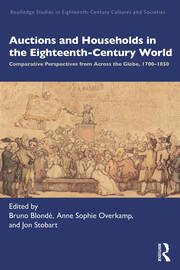
1st Edition
Auctions and Households in the Eighteenth-Century World Comparative Perspectives from Across the Globe, 1700–1850
Introduction Auctions and households. Shopping for the home between
tradition and innovation
Bruno Blondé, Anne Sophie Overkamp and Jon Stobart
PART 1 Selling: strategies, auctioneers and advertising
1 A window of opportunity: the country house sale at Haus Hueth in 1792
Anne Sophie Overkamp
2 His debts, her future: auctions and gendered power in colonial North America
Ellen Hartigan-O’Connor
3 Negotiating the bid: the art and book auctioneer in eighteenth-century Germany
Elizabeth Harding
4 Buying old? Selling new? Eighteenth-century auctioneers, advertising and St James’s Square, London
Kerry Bristol
5 Empire of auctions: advertising household sales in the Caribbean, India and England, c. 1790–1810
Tara Inniss, Jon Stobart and Christine Walker
PART 2 Buying: goods, practices and people
6 A world without stuff? Public auctions in a colonial setting. Kingston (New York) in the seventeenth century
Reinoud Vermoesen
7 ‘Therefore those who . . . would also desire to bid for his effects . . .’: public auctions of household goods in the Geltstag bankruptcy regime in urban and rural Bern (1660–1790)
Claudia Ravazzolo
8 Hammocks and calabashes: auction sales of household goods at the Suriname Society Hospital, c. 1760–75
Anne Wegener Sleeswijk
9 ‘Genteel and modern’: auctioning the household belongings of the parish clergy in Georgian England
Sara Pennell and Jon Stobart
Biography
Bruno Blondé is Professor at the Centre for Urban History, University of Antwerp. His research interests include the history of economic growth and social inequality, urbanisation, material culture and consumption, especially of the early modern Low Countries. Blondé is engaged in the Antwerp Interdisciplinary Platform for Research into Social Inequality (Aipril). He co-authored Inequality and the City in the Low Countries (1200–2020), 2020.
Anne Sophie Overkamp is Associate Professor of the History of Science and Technology at the Bergische University of Wuppertal. Her research focuses on economic history as cultural history, the material culture of German country houses and, most recently, the history of horticulture and botany. She is co-editor of the volume Encountering the Global in Early Modern Germany. Microhistories of Mobility, Materiality, and Belonging (2025).
Jon Stobart is Professor of History at Manchester Metropolitan University. His research centres on retailing, consumption and material culture in eighteenth-century England, from country houses through the material lives of parish clergymen to household sales. His most recent publication is Auctions and the Consumption of Second-Hand Goods in Georgian England (2026).
