




1st Edition
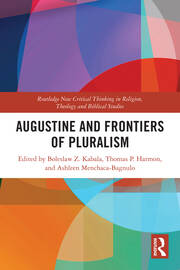
Augustine and Frontiers of Pluralism
Editors’ Introduction: Scope, Focus, and Purpose
1. Would It Have Killed Augustine to Be More Like Socrates? James Wetzel
Part 1: Augustine. Alternative Pluralisms
2. Augustine’s Flexibility in Encountering Pluralism Douglas Kries
3. The Philosophy and Politics of Universalism in the Time of Augustine Thomas Harmon
4. Augustine on Pagan and Christian Social Hierarchies Daniel E. Burns
5. E Pluribus Unum: Illiberal Pluralism at Cassiciacum Michael P. Foley
Part 2: Augustinian Pluralism and Civic Engagement
6. Hopefully, Augustine Peter Iver Kaufman
7. Healing Hope: A Response to Peter Iver Kaufman Veronica Roberts Ogle
8. Augustine on Hope and Politics Michael Lamb
9. Augustine and Pluralism in a Globalized World Charles Mathewes
10. Augustine and the Christian Response to Nazism Paul Allen
Part 3: Augustine and Black Religious Thought
11. Augustine in Dialogue with Frederick Douglass and Angela Davis on Human Freedom Ashleen Menchaca-Bagnulo
12. On Job and the Practical Problem of Suffering: Augustine and Martin Luther King, Jr. Compared Darren Yau
13. Africitas, or Fanon’s Confession: Manicheism and Pluralism in Augustine and Frantz Fanon Chase Padusniak
Part 4: Augustine, Identity, and Paradoxes of Domination
14. The Masters’ Metaphors and the Afterlife of Slavery: Re-reading Augustine’s ‘Form of the Slave’ Matthew Elia
15. Dominating Grief: An Ambiguously Augustinian Approach to Pregnancy Loss Trish Grosse Brewer
16. Critique without Domination? Fraternal Correction as Augustinian Social Witness John Walker
Part 5: Augustinian Feminism
17. Imitatio Christi as Humility: Augustine and Wollstonecraft toward a Pluralist Feminism Emily Dumler-Winckler
18. Too Late Have I Loved You: Misogyny, Sin, and Divinity in Confessions 6.15 Karmen MacKendrick
19. Obedience and Submission: Thinking with Augustine Vincent Lloyd
Part 6: Augustine, Freedom, and Liberalism
20. Obscurity, Perplexity, and Plurality in Augustine’s City of God Mary M. Keys
21. Decolonization and the Two Cities: Quijano, Augustine, and Paul Owen Anderson
22. Envy, Imagination, and the 'Eternal Flight' of Equality: Tocqueville’s Augustinian Perspective on Democracy’s Path to Despotism and the Death of Pluralism Vince Bagnulo
Part 7: Augustine and Pluralities of Time
23. African Temporalities: Race and the Augustinian Philosophy of Time Sean Hannan
24. In a Time of Reconciliation: Augustine and Jean-Francois Lyotard on Community Confession Boleslaw Z. Kabala and Kahlib Fischer.
Index
Biography
Boleslaw Z. Kabala is Assistant Professor of Political Science at Tarleton State University, USA, and Research Associate at the Augustinian Institute at Villanova University.
Thomas P. Harmon is Professor and Scanlan Foundation Chair in Theology at the University of St. Thomas, USA.
Ashleen Menchaca-Bagnulo is Associate Professor in the Department of Political Science at Texas State University, USA.
"Augustine and Frontiers of Pluralism is a feast. Across a diverse range of topics and voices, readers will encounter both the historical distance and contemporary resonance of the Augustinian tradition. Scholarly, but not scholastic in a pejorative sense, this volume represents the cutting edge of renewed efforts to think with Augustine and his contested legacy for our times."
- Eric Gregory, Princeton University, USA
"This expansive collection brings together work by established and up-and-coming scholars, reflecting an exciting variety of methods and perspectives. Augustine’s relevance is of course perennial, and a volume on pluralism couldn’t be timelier."
- Toni Alimi, Cornell University, USA
“Augustine was one of the great thinkers in the history of the west, someone whose thought has shaped its culture profoundly. But constant re-engagement is required to show the relevance of his thought to problems of current concern. Some of the needed work is done by this book. Teachers of Augustine at a variety of levels will find essays that will help them mine his writings for text that speak to questions students find pressing. But this scholarly collection is far more than a resource for teachers. Researchers who recognize Augustine's importance and influence want to see what he can teach us about the world in which we live. By bringing Augustine so closely into contact with contemporary problems and questions, this book will help scholars in philosophy, theology, religious studies and political theory do just that.”
- Paul Weithman, University of Notre Dame, USA
