




1st Edition
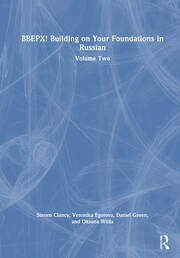
BBEPX! Building on Your Foundations in Russian Volume Two
10. У приро́ды нет плохо́й пого́ды 11. Пора́ в пу́ть-доро́гу! 12. Бу́дьте здоро́вы! 13. @ — дру́г челове́ка 14. Семе́йное сча́стье 15. Преступле́ние и наказа́ние 16. Война́ и ми́р 17. «Жизнь коротка́, иску́сство ве́чно» 18. Наше всё
Biography
Steven Clancy is Senior Lecturer in Slavic Languages and Literatures and Director of the Slavic Language Program at Harvard University, USA.
Veronika Egorova is Senior Preceptor in Russian at Harvard University, USA.
Daniel Green is Lecturer in Russian at the University of Bristol, UK.
Oksana Willis is Lecturer in Russian and Russian Language Coordinator at University of California, Berkeley, USA.
"With ever-changing methods and approaches to teaching foreign languages — from proficiency-oriented, to project-based, to open-architecture modules, to transformational teaching — students always need a strong toolkit for building on their foundations, especially for languages with such intricate morphological and syntactical structures as Russian. This book combines crisp and nuanced applied linguistics with a truly communicative approach, while also featuring a rich socio-cultural component. Close attention is paid to word formation, which promotes the development of reading comprehension capability. Language material is organized and introduced as a set of working tools ready to be used and reused for different topics. All of this and much more makes this textbook a unique resource for a wide range of learners and teachers — from undergraduates to graduate and professional students. In addition, Вверх! Building on your Foundations in Russian can serve as a hands-on teaching tool for graduate courses on methodologies of teaching Russian and applied linguistics. It represents a helpful resource for Russian instructors beginning their teaching career, as well as for independent study."
Irina Dolgova, Yale University, USA
"Вверх! Building on your Foundations in Russian is a title that reflects the volume’s insightful, well-measured, and stimulating progress through the salient properties of the Russian language. The textbook credits the learners with an ability to grasp the intricacies of grammar and offers a thorough and lucid linguistic commentary without being either overwhelming or simplistic. A selection of thematic dialogues and oral exercises allows for a diverse communicative practice, while samples of authentic texts and the authors’ rich notes on culture and usage highlight the language as a historical and social entity."
Anna Muza, University of California, Berkeley, USA
