





1st Edition
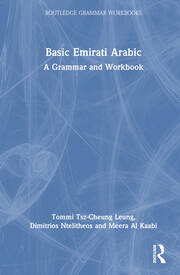
Basic Emirati Arabic A Grammar and Workbook
Preface
1 Introduction
2 Consonants
3 Vowels
4 Writing system
5 Word formation
6 Nouns
7 Pronouns
8 Form I verbs
9 Form II verbs
10 Form III verbs
11 Form V verbs
12 Form VI verbs
13 Form VII verbs
14 Form VIII verbs
15 Form IX verbs
16 Form X verbs
17 Intransitive, transitive, and ditransitive verbs
18 Verb nouns
19 Adjectives
20 Adverbs
21 Prepositions
22 Quantifiers
23 Numerals
24 Modality
25 Negation
26 Noun phrases
27 Construct states
28 Verb phrases
29 Complex verb constructions
30 The imperfective aspect
31 The perfective aspect
32 The grammatical aspect
33 Relative clauses
34 Questions
35 Subordination
36 Coordination
Key to exercises
Index
Biography
Tommi Tsz-Cheung Leung is Professor of Linguistics at the Department of Cognitive Sciences, United Arab Emirates University. He specializes in the syntax of Emirati Arabic and the psycholinguistics of Arabic and Southeast Asian languages.
Dimitrios Ntelitheos is Professor of Linguistics and Chair of the Speech Language Pathology Department at United Arab Emirates University. His research and published work focus on Malagasy, Greek, and Emirati Arabic morphological and syntactic structure and its acquisition by children.
Meera Al Kaabi is an Associate Professor at the Cognitive Science Department of UAEU and a visiting scholar at NYUAD. She works in neurolinguistics, psycholinguistics, language disorders, and Arabic morphology. She also has a professional background in academic administration and policy development.
