




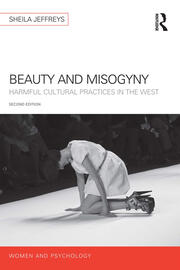
2nd Edition
Beauty and Misogyny Harmful cultural practices in the West
Introduction 1. The ‘grip of culture on the body’: beauty practices as women’s agency or women’s subordination 2. Harmful beauty practices and western culture 3. Transfemininity: ‘Dressed’ men reveal the naked reality of male power 4. Pornochic: prostitution constructs beauty 5. Fashion and Misogyny 6. Making up is hard to do 7. Men’s foot and shoe fetishism and the disabling of women 8. Cutting Up Women: beauty practices as self-mutilation by proxy Conclusion: A culture of resistance
Biography
Sheila Jeffreys is Professor in the School of Social and Political Sciences at the University of Melbourne, where she teaches sexual politics and international feminist politics. Before coming to Melbourne in 1991, she was active in the Women’s Liberation Movement in the UK from 1973, campaigning against pornography and violence against women, and in lesbian feminist politics. In Australia she is involved in the Coalition Against Trafficking in Women. She has written nine books on the history and politics of sexuality.
"This is without doubt the most sophisticated, well-researched, and compelling book ever written about the ways the ‘beauty’ industry produces and reproduces misogyny. Written from an unapologetically radical feminist perspective, students describe Beauty and Misogyny as transformative and life-changing."– Gail Dines, Professor of Sociology and Women's Studies, Wheelock College, Boston, USA
Praise for the first edition
"Beauty and Misogyny belongs in women's studies and public health classes and on the shelves of academics, clinicians, and parents of daughters. It would benefit any woman who was considering plastic surgery or buying a new tube of lipstick." – Michele Hoffnung, Quinnipiac University, USA in PsycCRITIQUES
"Jeffreys’ mission is to shift women out of their collective complacency. The book’s central theme is an exploration of the use of sexuality by men to dominate women. Jeffreys offers no comfort zone for her readers. Unlike some feminist theorists, she refuses to couch her arguments in inaccessible, academic language, or to accept that feminism has achieved its aims." – Julie Bindel, The Guardian
