




1st Edition
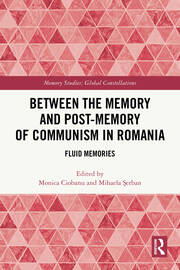
Between the Memory and Post-Memory of Communism in Romania Fluid Memories
Introduction
Monica Ciobanu and Mihaela Şerban
Part I Memory Archives
Chapter 1 Telling Difficult Stories with Fragments of Experience: Short-Term Ethnography in the Securitate Archives
Cristina Plǎmǎdealǎ and Cristian Tileagǎ
Chapter 2 Nested Orientalism and Memory Places: The Roma in Romanian Securitate Archives
Delia Popescu
Chapter 3 Law, Property Rights, and the Construction of Memory Regimes in Romania
Mihaela Şerban
Part II The Construction of Memories and Post-Memories
Chapter 4 Between Transitional Justice and Retrospective Justice: The Case of Mircea Vulcănescu
Monica Ciobanu
Chapter 5 The Monuments of the Royal Family and the Romanian Historical Memory
Cristian Vasile
Chapter 6 Memory and Post-Memory: Remembering the Communist Past in Digitally Mediated Contexts
Cristina Petrescu and Dragoș Petrescu
Chapter 7 Generations of Memory: Narratives of Conflicts, Gaps, and Intersections in Romanian Cinema
Simona Mitroiu
Part III Sites of Memory
Chapter 8 Rubbles of Memory: The Memorial Afterlives of Communist Monuments in Post-communist Romania
Mihai S. Rusu
Chapter 9 Nostalgic Reconstructions of the Communist Past: The Private Museums of Daily Life during Communism in Romania
Caterina Preda
Chapter 10 Popular Culture Exhibited: New Trends in the Musealization and Memorialization of the Romanian Socialist Past
Dalia Báthory
Chapter 11 Justice for the Forgotten Victims of the Communist Regime in Post-Transition Romania
Luciana M. Jinga
Conclusion
Joanna Wawrzyniak
Biography
Monica Ciobanu is Professor of Criminal Justice at Plattsburgh State University of New York, USA, and the author of Repression, Resistance and Collaboration in Stalinist Romania 1944–1964: Post-Communist Remembering.
Mihaela Şerban is Professor of Law and Society at Ramapo College of New Jersey, USA, and the author of Subverting Communism in Romania: Law and Private Property: 1945–1965.
“The past goes on. So too does memory of it, though not always in circumstances of its own choosing. Between the Memory and Post-Memory of Communism in Romania not only extends our knowledge of the Romanian case but makes key contributions to our understanding of the ways memory changes over time; “Between the Memory and Post-Memory” there is indeed a complex space of negotiation. This volume should thus be essential reading for the entire field of memory studies.” - Jeffrey Olick, University of Virginia, USA, former co-president, Memory Studies Association.
“This book presents a stimulating and insightful collection of chapters by an interdisciplinary team of scholars. It examines issues of trauma, justice, and nostalgia within Romania’s efforts to come to terms with its problematic communist past. A notable contribution of this volume is the attention to both the multiple sites of the memory of communism (both material and digital), and the gaps and contradictions within the way that Romania has dealt with the memory of communism. It is essential reading for anybody seeking to understand contemporary Romania.” - Duncan Light, Bournemouth University, United Kingdom
“How is communism remembered by Romanians who never experienced it directly? In this edited volume, thirteen Romanian scholars respond to this question by showing how post-communist concerns and interests shape and reshape the memory of the past in that country. An impressive array of examples and case studies documents the “regimes of truths” discussed publicly, identifies continuities between communist and post-communist habits, and underscores conflicting and complementary patterns of remembrance that bring together personal positions, gamification of the past, and even fake information. A welcomed addition to the literature, this volume illuminates overlooked facets which suggest a memory turn.” - Lavinia Stan, St. Francis Xavier University, Canada
