





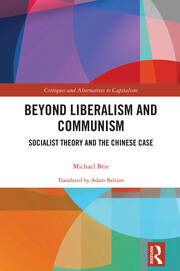
1st Edition
Beyond Liberalism and Communism Socialist Theory and the Chinese Case
Introduction: Why Have So Many Cathedrals of Socialism Collapsed?
Part One: Socialist Theory
1. Socialism in Conflict with Communism and Liberalism
2. If You Aren’t Willing to Talk about the Strengths of Capitalism, You’d Better Keep Quiet about Socialism
3. Marx’s Confidence, Neurath’s Utopia, and Mises’ Verdict on the Impossibility of Socialism as a Rational Economic Order
4. Karl Polanyi’s Search for Freedom in a Complex Society
5. Socialism: Using Solidarity to Address the Contradiction between the Free Development of Each and the Free Development of All
Part Two: China’s Socialism
6. Beyond the Frog’s-Eye Perspective
7. Deng Xiaoping’s Sleeplessness and the Chinese Dream
8. Socialism or State Capitalism?
9. The CCP as Communist Emperor: China’s Refoundation and Socialist Transformation
10. China’s Transformation as Hegemonization of Society through the Communist Party
11. The Effect of the Two General Formulas of Socialism in China
12. Is Liberal Democracy the Only Democracy?
13. Socialism as a Planned Economy
14. The Chinese Nation and Policy in Xinjiang
15. The Strengths and Weaknesses of China’s Social System
16. China’s (Re-)Emergence as One of the Centres of the World
Biography
Michael Brie is a former senior research fellow at the Institute for Critical Social Analysis at the Rosa Luxemburg Foundation, Germany. Now retired, his research explores the theory and history of socialism, the socio-ecological transformation of modern societies, and contemporary strategic questions facing the Left. He is the co-author of Rosa Luxemburg: A Revolutionary Marxist at the Limits of Marxism (2021), author of Rediscovering Lenin: Dialectics of Revolution and Metaphysics of Domination (2019), and co-editor of Karl Polanyi’s Vision of a Socialist Transformation (2018).
