





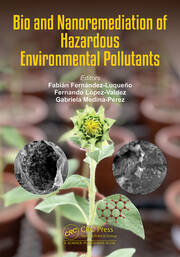
1st Edition
Bio and Nanoremediation of Hazardous Environmental Pollutants
SECTION 1
The Jeopardized Soil
Mariana Miranda-Arámbula, Ada María Ríos-Cortés, Gabriela Medina-Pérez, Fabián Fernández-Luqueño, Pedro Antonio López and Fernando López-Valdez
Isoproturon Herbicide Interaction with Crops and Biodegradation
Himani Singh, Gurminder Kaur, Shubhra Khare and Vijaya Yadav
New Paradigm in Algae-based Wastewater Remediation
Pankaj Kumar Singh and Archana Tiwari
Microbial Communities and GHG Emissions from Polluted Agricultural Soils Remediated with Several Amendments
Gabriela Medina-Pérez, Fabián Fernández-Luqueño, Fernando López-Valdez, Alfredo Madariaga-Navarrete, Elizabeth Perez-Soto, Isaac Almaraz-Buendía, Rafael Germán Campos-Montiel and Oscar Fernández-Fernández
Agricultural Nanotechnologies to Improve the Crops’ Quality, Increasing their Yields and Remediating Polluted Soils
Gabriela Medina-Pérez, Sergio R. Pérez-Ríos, Fabián Fernández-Luqueño, Rafael G. Campos-Montiel, Alfredo Madariaga-Navarrete and Fernando López-Valdez
SECTION 2
Genetically Modified Plants for Phytoremediation Biotechnological Microbial Remediants: Enhanced Pedospheric Detoxification Accomplished via Transgenic Plants
Shaan Bibi Jaffri and Khuram Shahzad Ahmad
Synthesis and Applications of Transition Metal Oxide Nanoparticles for Bacteria Disinfection and Virus Inactivation in the Environment
Yolanda G. Garcia-Huante, Martha A. Gomez-Gallegos, Oscar D. Máynez-Navarro, Erick R. Bandala and Irwing M. Ramirez
Synthesis of Carbon-based Nanomaterials and their use in Nanoremediation
Kien A. Vu and Catherine N. Mulligan
Green Synthesis of Nanomaterials and their use in Bio-and Nanoremediation
Manuel Palencia and Angélica García–Quintero
Nanoremediation of Hazardous Environmental Pollutants
Anita Grozdanov, Perica Paunović, Katerina Burevska Atkovska and Mirko Marinkovski
Chemical and Biochemical Process Involved in the Degradation of Hazardous Contaminants through Bio and Nanoremediation
Giovanni Arneldi Sumampouw, Antonius Indarto, Veinardi Suendo and Muhammad Mufti Azis
Environmental Remediation by Novel Nanomaterials and Fungi with High-degradation Capacity of Hazardous Contaminants
Mohd Faheem Khan and Cormac D. Murphy
Nanomaterials and Edible or Nonedible Crops for Dissipate Pollutants: Using Nanotechnology to Bioremediate the Environment
García-Mayagoitia Selvia, Fernández-Luqueño Fabián, Medina-Pérez Gabriela, López-Valdez Fernando, Campos-Montiel Rafael and Mariana Miranda-Arámbula
Conducting Polymers Based Nanocomposites for the Environmental Pollutants Detection
Thatchanamoorthy Thenrajan and Jeyaraj Wilson
Biography
Dr. Fabián Fernández-Luqueño is a Full Professor at the Center for Research and Advanced Studies of the National Polytechnic Institute (Cinvestav Saltillo), Mexico. He received a Bachelor’s degree in engineering in soil science, his M.Sc. in edaphology, and a Ph.D. in Biotechnology. His research area is plant-environment interactions, bio- and nano-remediation, agricultural nanotechnology, and the effect of nanomaterials on crops, soils, and microorganisms. Fabián has authored more than 65 scientific papers, 12 science articles, 17 books, and 35 book chapters, and has been a reviewer of more than 20 high-impact peer-reviewed journals (Ranked in JCR-Q1) and associate editor from Heliyon (IF = 3.772) & Terra Latinoamericana (Scopus). He has been a dissertation advisor for undergraduate, bachelor, master, and Ph.D. degrees. Fabián is a member of Researchers-National Systems in level II, Mexican Academy of Sciences, and is currently vice-president of the Mexican Society of Soil Science.
Dr. Fernando López-Valdez is a full Professor at the Research Centre for Applied Biotechnology (Centro de Investigación en Biotecnología Aplicada), Instituto Politécnico Nacional, Mexico. He is a Bachelor grade in Chem. Engineering (UV, México). M.Sc. Degree in Biotechnology (Bioprocesses) and Ph.D. in Biotechnology (Agricultural Biotech.) from CINVESTAV, Mexico. Dr. Fernando López-Valdez has been a Postgraduate professor for more than 20 years. He is also a Author or co-author of over 20 book chapters, two books as Editor, over 20 articles papers (JCR or peer-reviewed). He has lectured for science divulgation on Biotechnology, Agricultural, and Environmental Biotechnology fields. Currently, he is the Associate Editor for Terra Latinoamericana Journal, Mexican Society of Soil Science (SMCS).
Dr. Gabriela Medina-Pérez is a Doctor of Science from the Scientific and Technological Development Program for Society with an emphasis on Agricultural Nanotechnology from the Center for Research and Advanced Studies of the National Polytechnic Institute (CINVESTAV-IPN). She is a Master in Food Sciences from the Autonomous University of the State of Hidalgo (UAEH) and an Agroindustrial Engineer from the Institute of Agricultural Sciences of UAEH (ICAP-UAEH). She is a member of the National System of Researchers (SNI) with a recent entry at the candidate level. An active member of the International Network of Government Scientific Advice (INGSA) since 2018. She is currently a full-time research professor in the academic area of agro-industrial engineering and food engineering at the ICAP-UAEH. She is also the general coordinator of the institute’s outreach. She has participated as lead author and co-author in several indexed articles, book chapters, and conference proceedings on bioactive compounds, nanotechnology, agricultural biotechnology, and sustainable development.
