




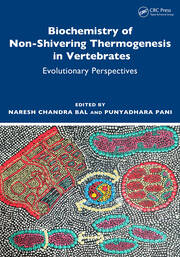
1st Edition
Biochemistry of Non-Shivering Thermogenesis in Vertebrates Evolutionary Perspectives
Unit 1:- NONSHIVERING THERMOGENESIS THROUGH BROWN FAT AND ALLIED MECHANISMS
1. Evolutionary and developmental origin of brown adipose tissue
Sunil Pani and Naresh C Bal
2. Molecular mechanisms of heat production in brown adipose tissue
Bijayashree Sahu and Naresh C Bal
3. Neurohormonal regulation of heat production in brown adipose tissue
Anuttama Pal and Naresh C Bal
4. Thermogenic Determinants in Hibernation Models
Moriah Hunstiger and S. Ryan Oliver
Unit 2:- SKELETAL MUSCLE NONSHIVERING THERMOGENESIS: EVOLUTIONARY, MECHANISTIC AND ECOLOGICAL ASPECTS
5. Endothermy in Fishes: A Remarkable Story of Convergent Evolutionary Adaptation.
Jens P.C. Franck and Sean Robinson
6. Whole-body endothermy and non-shivering thermogenesis (nst) in today’s birds and mammals and in their past
Gordon Grigg
7. Non-shivering thermogenesis in birds: A role for skeletal muscle
Jose Eduardo Pereira Wilken Bicudo, Kênia Cardoso Bicego and Punyadhara Pani
8. Ryanodine Receptor 1 calcium leak in non-shivering thermogenesis
Aldo Meizoso-Huesca and Bradley S Launikonis
9. Futile SERCA-mediated calcium cycling activity as the basis for non-shivering thermogenesis in the skeletal muscle
Naresh C. Bal and Muthu Periasamy
10. Recruitment of non-shivering thermogenesis in skeletal muscle: Importance of environmental context
Colleen M Novak and Christina A Watts
Unit 3:- BIOMEDICAL RELEVANCE OF NONSHIVERING THERMOGENESIS
11. Targeting mitochondrial energy efficiency to treat chronic metabolic diseases
Sam D. Houma, Julius L. Larion, Abraham Karim, and Shona Mookerjee
12. Muscle-based thermogenesis and its physiological implications for obesity and muscle health
Bianca M. Marcella, Jessica L. Braun, Mia S. Geromella and Val A. Fajardo
13. Recruitment of brown and beige adipose tissue thermogenesis through muscular activity
Leslie A. Rowland
14. Phytochemicals as potential candidates to combat obesity via non-shivering thermogenesis
Hanbing Li, Yuanhai Sun, Tengjiao Zhao, Sunying Cheng
Biography
Dr. Naresh Chandra Bal
Associate Professor
KIIT School of Biotechnology
Bhubaneswar, Odisha
Dr. Bal has more than 15 years of research experience in muscle and brown adipose tissue (BAT) thermogenesis. He also possesses more than 20 years of teaching experience in physiology and biochemistry related subjects at different levels. He has designed and performed studies on several transgenic mouse models using manipulation of thermogenic capacities of both the sites: BAT and muscle. In addition to these transgenic models he has also employed other strategies such as pharmacological, surgical and diet-intervention to address questions related to thermogenesis, especially non-shivering thermogenesis (NST). Dr. Bal has authored more than 30 manuscripts on this topic including top-tier journals such as Nature Medicine, Trends in Endocrinology and Metabolism, Biological Reviews, Journal of Biological Chemistry (JBC), and Biochemical Journal. He has published 60 journal articles in total and his papers have been cited by top researchers in the field from all over the world. Currently, his H-index is 30 with total citation of more than 3000. For his pioneering research, Dr. Bal has been awarded with several honors including Physiological Genomics Fellowship, American Physiological Society (APS), USA; K01 Award from National Institutes of Health (NIH), USA; Ramalingaswami Re-entry Fellowship, Government of India; and Early Career Research Award, Government of India. He serves as associate editor in Frontiers in Physiology and editor in Metabolites & Molecular Medicine Reports. Due to his scientific contribution he has been elected as the Fellow of the Royal Society of Biology, UK.
Ms. Punyadhara Pani
Senior Research Fellow
KIIT School of Biotechnology
Bhubaneswar, Odisha
Ms. Punyadhara Pani is currently working in the laboratory of Dr. Bal in delineating molecular mechanisms of muscle non-shivering thermogenesis (NST) in birds. She completed her bachelor's degree from Utkal University and master's from Ravenshaw University with Summa-cum-Laude. She served as a teacher and taught undergraduate students for about five years. Due to her excellent academic distinctions, she has been awarded with one of the most competitive pre-doctoral research funding called DST-Inspire Fellowship from the Government of India. She is admirable in writing and has won first prize in several state-level competitions. She designed and developed her manuscripts which have been published in several renowned journals including Biological Reviews, Biochemical Journal, among others. Moreover, Ms. Pani has successfully presented her work in the form of poster and oral presentations in both national and international conferences for which she has received recognition and awards. She has done extensive research on skeletal muscle adaptation to environmental factors, pharmacological agents and cytokines leading to several recent publications in internationally reputed journals. For these studies, she has used different animal models including mammalian and avian providing biochemical/genetic insight for NST in the muscle.
