




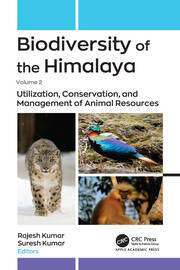
1st Edition
Biodiversity of the Himalaya Volume 2: Utilization, Conservation, and Management of Plant Resources
1. Indian Traditional Knowledge in Relation to Animal Origin Products with Special Reference to Insects
Rajesh Kumar, Suresh Kumar, Arup Giri, and Younis Ahmad Hajam
2. The Himalayas: A Hotspot of Biodiversity
Ritika Anthal, Raman Jasrotia, and Ravindra Kumar Dhaka
3. Effect of Changing Climatic Conditions on Faunal Diversity of Northwestern Himalaya
Priya Anand and Phulan Rani
4. Impact of Chemical and Synthetic Pesticides on Himalayan Insect Diversity
Amit Layek, Debarati Seal, Kaushik Pramanik, Rakesh Das and Debashis Mandal
5. Impact of Anthropogenic Activities on Faunal Diversity of the Snow-Covered Himalayan Range
Arup Giri, Ajay Balda, Manisha, Manju, Avilekh Naryal, and Rajesh Kumar
6. Conservation Strategies for Threatened Faunal Diversity of Himachal Pradesh
Prem Lata, Younis Ahmad Hajam, Ajay Kumar, and Rajesh Kumar
7. Ecotourism: Frenemy of Himalayan Diversity
Acharya Balkrishna, Priyanka Yadav, Aakanksha Saini, Priya Yadav, Brijesh Kumar, and Ved Priya Arya
8. Effect of Invasive/Alien Animal Species in the Himalayan Faunal System
Younis Ahmad Hajam, Neelam, Muddasir Basheer, Rajesh Kumar, Suresh Kumar, and Arup Giri
9. Impact of Mobile Tower Radiation on Himalayan Fauna
Rajesh Kumar, Ajay Kumar, Suresh Kumar, Younis Ahmad Hajam, and Ankush Sharma
10. Socio-Economic Evaluation of Insect Products with Special Reference to Himalayan Honeybees
Bindu Gudi Ramakrishna, Jasti Sri Vishnu Murthy, Marneni Divya Sree, Penuballi Swathi, Desavath Gouthami, Shreya Singh, and Vinod Kumar Dubey
11. Cordyceps militaris: An Entomopathogenic Fungus as a Promising Solution for Conservation of Himalayan Cordyceps
Anita V. Handore, Lalit K. Patil, Sharad R. Khandelwal, Rajib Karmakar, Mithun Rudrapal, Manjiri S. Ghorpade, Sharmila S. Ghangale, Vijaya S. Ghayal, Abhijeet S. Jagtap, and Dilip V. Handore
12. Hunting, Habitat Destruction, and Human Fun as Potential Threat to Himalayan Diversity
Neha Katnoria, Gurinder Kaur Walia, Rajesh Kumar, Dalveer Singh Soma, Prem Lata, and Neenu Daroch
13. Narpuh Wildlife Sanctuary, Meghalaya: Status, Challenges, Sustainable Benefits and Future Perspectives
R. Eugene Lamare, Niraj Kakati, and Gautam Talukdar
Biography
Rajesh Kumar, PhD, is an Assistant Professor of Biosciences at Himachal Pradesh University, Shimla, India. With over 10 years of experience in teaching and research, he has been teaching animal physiology and applied zoology and supervising students for their research work. His own research activities also include environmental toxicology, waste management, and the impact of environmental degradation on animal physiology. He is an expert lecturer at beekeeping training/extension activities. Dr. Kumar has successfully completed two major research projects and two startup projects sponsored by government agencies and has published research articles, book chapters, abstracts, and conference papers as well as several books and monographs. He has successfully organized seminars and conferences and delivered invited talks and extension lectures.
Suresh Kumar, PhD, is an Associate Professor in the Department of Bio-Sciences, H.P. University, Shimla, India. He has more than 12 years of experience in teaching and research. His thrust areas include floristics, ethnobotany, and biodiversity. Dr. Kumar has published 10 books and more than 20 research papers in journals of national and international repute. Presently, he is guiding several students for their PhD degrees. He has participated in many conferences and seminars and has delivered invited talks as a resource person at various institutions. He is a member of the Indian Science Congress and many other scientific agencies. He is an associate editor as well as a reviewer for various journals in the field of botany.
“Rich and diverse in content . . . presents an extensive range of chapters on different key aspects associated with Himalayan plant diversity . . . considering the rich floristic diversity, high endemism, and vulnerability to the emerging threats to these ecologically fragile and sensitive ecosystems . . . A detailed account on existing studies with reference to floristics, ecology of habitats, the status of medicinal and threatened species . . . A wonderful endeavor.”
—From the Foreword by Anil Prakash Joshi, PhD, Founder, Himalayan Environmental Studies and Conservation Organization (HESCO), Dehradun, India
