




1st Edition
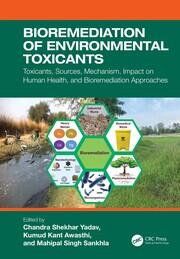
Bioremediation of Environmental Toxicants Toxicants, Sources, Mechanism, Impact on Human Health, and Bioremediation Approaches
Section 1: Introduction to Environmental toxicants
1. Pesticides as Environmental Toxicants
Ashna Bhatia, Chandra Shekhar Yadav, and Basu Dev Banerjee
2. Heavy Metals as Environmental Toxicants
Dharmveer Yadav and Praveen Sharma
3. Plastic and Microplastic Wastes as Environmental Toxicants
Pragya Pant, Diwakar Chauhan, Monika Chauhan, Ajay Kumar, and Amrita Kaushik
4. Industrial Waste as Environmental Toxicants
Neelkant Verma, Nandini Gupta, and Gameli Prince Sellase
5. Biomedical Wastes as Environmental Toxicants
Monika, Taruna Lodhi, Richa Rohatgi, and Seema R. Pathak
Section 2: Nanoparticle-based remediation strategies for environmental toxicants
6. Nanoparticle-Based Bioremediation Approach for Pesticides
Tushar Tyagi, Parshant Dahiya, Aatmika Barve, Anoop M. Divakaran, Kumud Kant Awasthi, and Chandra Shekhar Yadav
7. Nanoparticle-Based Bioremediation Approach for Elimination of Heavy Metals from Wastewater
Seema Manwani, Garima Awasthi, Swati Gupta, Anjali Awasthi, Chandra Shekhar Yadav, and Kumud Kant Awasthi
8. Nanoparticle-Based Bioremediation Approach for Plastics and Microplastics
Bhumit Chavda, Vishal M. Makwana, Tosha Gor, Ankita Patel, Mahipal Singh Sankhla, and Dipak Kumar Mahida
9. Nanoparticle-Based Bioremediation Approach For Industrial and Biomedical Wastes
Pritam P. Pandit, Sankalpa N. Navathar, Renu Devi, Mahipal Singh Sankhla, Kumud Kant Awasthi, Tina Sharma, Anjali Awasthi, and Garima Awasthi
10. Impact of Nanoparticle-Based Bioremediation on the Fauna and Flora of Different Matrices
Shivangi Giri, Lata Shahani, Sujata Sharma, Muhammad Mubaashshir, P.J. John, and Kumud Kant Awasthi
Section 3: Microorganism-based remediation strategies for environmental toxicants
11. Microbial Approaches for Bioremediation for Pesticides
Ditiksha Mandanka, Jaini Patel, and Narendra Kumar
12. Microorganism-Based Bioremediation Approach for Heavy Metals
Manish Yadav, Suwa Lal Yadav, Rameshwar Choudhary, and Arun Kumar
13. Microorganism-Based Bioremediation Approach for Plastics and Microplastics Wastes
Pavan Kumar Ganechary, Adheethi B, Avantika Choudhary, and Chandra Shekhar Yadav
14. Microorganism-Based Bioremediation Approach for Industrial and Biomedical Waste
Pravin S. Deshmukh and Ranjeet Kumar
15. Impact of Microorganism-Based Bioremediation on the Fauna and Flora of Different Matrices
Abhishek Mathur, Akshma Koul, Ankita Rani, and M.S. Reddy
Section 4: Phytoremediation: Bioremediation strategies for environmental toxicants
16. Phytoremediation: Bioremediation Approaches for Environmental Toxicants
Shiv Kumar Giri and Vivek Kumar
17. Phytoremediation: Treatment Strategies for Industrial and Biomedical Waste
Love Singla, Anita Saini, Vivek Kumar, Gulab Singh, Anil Kumar, and Shiv Kumar Giri
18. Impact of Phytoremediation-Based Bioremediation on Fauna and Flora of Different Matrices
Priya Borah and Hemen Deka
Biography
Dr. Chandra Shekhar Yadav is currently working as Assistant Professor at School of Forensic Sciences, National Forensic Sciences University, Gnadhinagar, Gujarat. He has earned his Ph.D. in Medical Biochemistry from the University of Delhi, India. He has worked as Assistant Professor at the Department of Life Sciences, Vivekananda Global University, Jaipur. He has been awarded the Dr. DS Kothari Postdoctoral Fellowship from UGC, New Delhi. He has published more than 25 papers in peer-review international Journal having high impact factors and presented papers in various national and international conferences. Area of research interest is environmental toxicology particularly emphasizing exposure to environmental toxicants and their impact on human health. He is an active Editorial Board member and reviewer of national and international Journals. He has expertise in the assessment of environmental residue by GC-MS and AAS, Pesticide induced toxicity studies, attenuation effect of plant extracts, genetics studies using PCR- RT PCR, and almost all the minor techniques. He has worked in various collaborative projects with the Central Pollution Control board (CPCB), New Delhi.viz., Environmental health- POPs estimation in Delhi Population. He is also a nominated member of the committee for the ethical use of laboratory animals in research by CPCSEA, Ministry of Environment Forest & Climate Change, Govt of India. More than 14 students have completed their master's dissertation under his exemplary guidance and currently, 4 research scholars are pursuing their Ph.D. under his supervision in the area of environmental toxicity and remediation.
Dr. Kumud Kant Awasthi is currently working as Professor and Head, Department of Life Sciences, Vivekananda Global University Jaipur. He has served as Assistant Professor at the National Institute of Animal Welfare, Faridabad India, and Lal Bahadur Shastri P. G. College Jaipur. Dr. Awasthi completed BSc from CSJM University Kanpur in 2002 then moved to Jaipur and earned an M.Sc. (Zoology) and Ph.D. from the University of Rajasthan Jaipur India. His area of research is environmental toxicology concerning nanoparticles. He has vast experience in the field of toxicity assessment for different nanomaterials in different in vivo and in vitro models and their safe use for drug development. He is also guiding Ph.D. scholars for their degrees. He is a life member of esteemed scientific national and international societies viz., STOX, ISCA, MRSI, ISLS, ISID, ESTIV, SMRS, and also nominated member of the committee for the ethical use of laboratory animals in research by CPCSEA, Ministry of Environment Forest & Climate Change Govt of India. He is constantly involved in research activity as a member of editorial boards, reviewers of different journals, and organizing committees of national and international conferences.
Dr. Mahipal Singh Sankhla is currently working as an Assistant Professor, Department of Forensic Science, (UIAHS), Chandigarh University, Mohali, Punjab India & University Centre for Research and Development, Chandigarh University, Mohali Punjab India. Prior to this, he has served as Assistant Professor, Department of Forensic Science, Vivekanda Global University, Jaipur, Rajasthan and Assistant Professor in the Department of Forensic Science, Institute of Sciences, SAGE University, Indore, M.P. He has done training in Forensic Science Laboratory (FSL) Lucknow, CBI (CFSL) New Delhi, Codon Institute of Biotechnology Noida, Rajasthan State Mines & Minerals Limited (R&D Division) Udaipur. He was awarded “Junior Research Fellowship-JRF”, DST-Funded Project at “Malaviya National Institute of Technology- MNIT”, Jaipur and “Excellence in Reviewing Award” in International Journal for Innovative Research in Science & Technology (IJIRST). He is the author of 3 Book and published 4 Book Chapters in various National and International publishers. He has been published more than 90 Research & Review Papers and organized more than 25 National and International Conferences, Workshops & FDP.
