




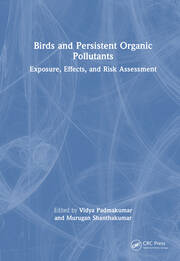
1st Edition
Birds and Persistent Organic Pollutants Exposure, Effects, and Risk Assessment
Preface
Contributors
Editor Bios
Introduction
Chapter 01 Persistent Organic Pollutants in Avian Ecotoxicology
AH Manjunatha Reddy, Yashashwini C, Nikitha L, Spurti Prakash Patil, and Sumathra Manokaran
Chapter 02 Persistent Organic Pollutants and Their Impact on Avian Survival: Characteristics and Case Study Insights
Gauri Lakshmi, and Revathy V. S
Chapter 03 Bioaccumulation of Persistent Organic Pollutants in Antarctic Penguins
Vidya Padmakumar, and Murugan Shanthakumar
Chapter 04 Persistent Organic Pollutants in the Greater Rhea (Rhea americana): Ecological Exposure Pathways, Bioaccumulation Dynamics, and Conservation Implications in Agricultural Landscapes of South America
Murugan Shanthakumar, and Vidya Padmakumar
Chapter 05 Effects of POPs on Avian Physiology
Ramneek Kaur, Daamini Arora, and Shalini Gupta
Chapter 06 Endocrine Responses of Arctic Seabirds to Persistent Organic Pollutants: Insights from Black-Legged Kittiwakes (Rissa tridactyla)
Murugan Shanthakumar, and Vidya Padmakumar
Chapter 07 Oxidative Stress Pathways Linked to Persistent Organic Pollutant Exposure in Seabirds: Implications for the Black-backed Gull (Larus dominicanus)
Robert Jameson, Vidya Padmakumar, and Murugan Shanthakumar
Chapter 08 Assessing Risks of Persistent Organic Pollutants (POPs) For Nesting Colonies of Birds of Prey and Seabirds in the North-Western Indian Ocean Ecosystems
Vanda Mendonca, Hermanus Grobler, Steve Dover, Rita Bicho, Boutrus Abi-Aoun, and Mazen Aldarhe
Chapter 09 Biochemical Insights of Vulture Population in Nepal with Respect to Assessing Risks of Persistent Organic Pollutants for Avian Species and Ecosystems
N Hao, Vidya Padmakumar, and Murugan Shanthakumar
Chapter 10 The Barn Owl as a Biomonitor for Persistent Organic Pollutants
Vidya Padmakumar, and Murugan Shanthakumar
Chapter 11 An Ecological Perspective of Raptor Ecotoxicology in Spain: From DDT to PFAS
Shoaib Akhtar, Murugan Shanthakumar and Vidya Padmakumar
Chapter 12 Governing Persistent Organic Pollutants (POPs) In Poultry Farming in the Context of Viet Nam
Nguyen Bang Nong, Van Hong Thi Ha, Lan Thi My Lam, and Huyen Le Thuong
Biography
Dr. Vidya Padmakumar is a biologist and ecotoxicologist whose work focuses on avian systems, environmental contamination, and ecological risk assessment. Her research examines how persistent organic pollutants move through ecosystems and manifest in bird populations, with particular emphasis on biomonitoring, trophic transfer, and species-level responses. She completed her doctoral studies at Mangalore University and has since been actively involved in interdisciplinary research, scientific publishing, and environmental consulting. Dr. Padmakumar is affiliated with the EcoDiversity Research Centre in British Columbia, Canada, where she contributes to ecological and human health risk assessment projects. In addition to her research, she plays an active role in scientific communication and editorial work, serving as Editor-in-Chief of The IOU Flutter, the magazine of the International Ornithologists’ Union. Her interests lie in connecting field ecology with applied environmental science and in strengthening the role of avian studies in understanding global contaminant dynamics.
Dr. Murugan Shanthakumar is an environmental scientist and ecotoxicologist with broad expertise in contaminant dynamics, environmental risk assessment, and ecosystem-level analysis. His work integrates chemical, ecological, and human health perspectives to evaluate the impacts of pollutants across terrestrial and aquatic systems. Over the years, he has been involved in a wide range of research and consulting initiatives, contributing to environmental monitoring, risk assessment frameworks, and multidisciplinary project development through the EcoDiversity Research Centre. Dr. Shanthakumar has a strong focus on applied science, particularly in translating complex ecotoxicological data into meaningful insights for environmental management and policy. His research interests span persistent organic pollutants, emerging contaminants, and the interactions between environmental stressors and ecosystem health. He has collaborated with researchers and institutions across regions and continues to contribute to advancing integrative approaches in environmental science and sustainability.
Together, the editors bring complementary strengths in avian ecotoxicology and environmental risk assessment, combining field-based ecological insight with applied analytical frameworks. Their collaborative work reflects a shared commitment to understanding the role of persistent pollutants in shaping ecological systems and to developing science-based approaches for monitoring and conservation.
"This book addresses a genuine and timely gap in the scientific literature. Although persistent organic pollutants have been extensively studied, there is currently no comprehensive and globally focused synthesis dedicated to avian species. The editors’ aim to bridge fundamental ecotoxicology, physiology, and applied conservation practice is both relevant and necessary. The book will become an important reference for scientists, environmental managers, and policy professionals working in wildlife health and pollution assessment."
Dr Damien Nzabanita, Ecotoxicology Research Group, RMIT University, Australia.
