





1st Edition
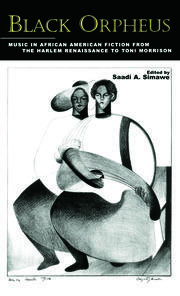
Black Orpheus Music in African American Fiction from the Harlem Renaissance to Toni Morrison
By Saadi A. Simawe
Copyright 2000
294 Pages
by
Routledge
304 Pages
by
Routledge
294 Pages
by
Routledge
Also available as eBook on:
The legendary Greek figure Orpheus was said to have possessed magical powers capable of moving all living and inanimate things through the sound of his lyre and voice. Over time, the Orphic theme has come to indicate the power of music to unsettle, subvert, and ultimately bring down oppressive realities in order to liberate the soul and expand human life without limits. The liberating effect of... Read more
What's in a Sound? The Orphic Theme of Music in African American Fiction, Saadi A. Simawe; Singing the Unsayable: Theorizing Music in Dessa Rose, Jacquelyn A. Fox-Good; Claude McKay: Music, Sexuality, and Literary Cosmopolitanism, Tom Lutz; It Don't Mean an Thing If It Ain't Got That Swing: Jazz's Many Uses for Toni Morrison, Alan Rice; That Old Black Magic?: Gender and Music in Ann Petry's Fiction, Johanna X., K. Garvey; Shange and Her Three Sisters; Sing a Liberation Song: Variations on the Orphic Theme, Maria V. Johnson; Black and Blue: The Female Body of Blues Writing in Toomer, Morrison, and Jones, Kathy Boutry; Nathaniel Mackey's Unit Structures, Joseph Allen; Black Moves, White Ways, Every Body's Blues: Orphic Power in Langston Hughes's The Ways of White Folks, Jane Olmstead; Siren Songs, Jungle Music, and the Black Vernacular in Works by Baldwin, Ntozake Shange, and Ishmael Reed, Chezia Thompson Cager; Music and Memory in Toni Morrison's Novels, Veeno Deo; Shamans of Song: Music and the Politics of Culture in Alice Walker's Early Fiction, Saadi A. Simawe
Biography
Saadi Simawe is Assistant Professor of English and Africana Studies at Grinnell College, Iowa.
