




1st Edition
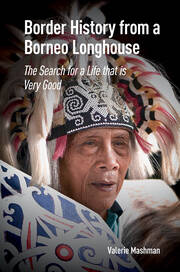
Border History from a Borneo Longhouse The Search for a Life that is Very Good
Biography
Valerie Mashman is an Associate Research Fellow at the Institute of Borneo Studies, Universiti Malaysia Sarawak. Her research interests in the field of anthropology examine issues of oral history and narratives, peace-making, values and social change, indigeneity, gender and material culture with a particular focus on indigenous peoples of Borneo.
"Border History is a valuable addition to Borneo Studies... Mashman's commentary adds important cultural and historical detail and highlights alternative renderings of the stories, such as colonial and other accounts of the same events and individuals. Rather than diminishing Melian's narratives, such contextual analysis enriches them, underscoring the very human hopes, fears, and dilemmas that underlay their telling."
Liana Chua, University of Cambridge, Asian Studies Review"Rather than simply relate stories, Mashman analyses the narratives to explore Kelabit ideas of identity; of belonging to lun tauh (our people); of what is regarded as making a person lun doo' (a good person). In short, Mashman examines the Kelabit way of being in and perceiving the world... A short review cannot do full justice to Mashman's work. Suffice to say, it should be read by all Borneo and wider Austronesian scholars, and has much to offer anthropologists in general."
Mary Hawkins, University of Sydney, Oceania, Vol. 95, Issue 2 (2025)
"This book is a valuable addition to Borneo Studies. Mashman provides a rich contextualisation of the narratives… explaining and exploring aspects of Kelabit culture and society and looking at parallel narratives about the events in Melian’s narratives coming from other sources, such as Brooke and colonial records.
The book also has wider relevance in a regional context, as many of the themes… are relevant more widely in Borneo and indeed in Southeast Asia... including ancestry, status and hierarchy, alliance, ethnic identity, attachment to place, the role of rice and rice-growing, and local attitudes to nomadic hunter-gathering… and beliefs about power…"
Monica Janowski, University of Hull, Borneo Research Bulletin, Vol. 55 (2025), pp. 257-259
"One of the book's most compelling strengths is its portrayal of the Kelabit people actively negotiating their identity, maintaining their community, and embracing change on their own terms... It is an important resource for Borneo specialists and anthropologists, but it is also highly accessible to any reader who wants to understand how a community keeps its identity alive while embracing a changing world."
Terry Justin Dit, Curtin University Malaysia, JMBRAS
