




1st Edition
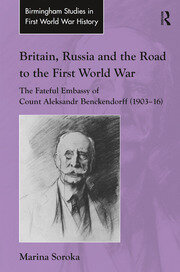
Britain, Russia and the Road to the First World War The Fateful Embassy of Count Aleksandr Benckendorff (1903–16)
By Marina Soroka
Copyright 2011
336 Pages
by
Routledge
336 Pages
by
Routledge
332 Pages
by
Routledge
Also available as eBook on:
For much of the later nineteenth-century Britain regarded Russia as its main international rival, particularly as regarded the security of its colonial possessions in India. Yet, by 1907 Russia's political revolution, financial collapse and military defeat by Japan, transformed the situation, resulting in an Anglo-Russian rapprochement. As this book makes clear, whilst international affairs lay at... Read more
Contents: Preface; The premises, 1830-1900; Old diplomacy à la russe, 1868-1902; The new ambassador and his objectives 1902-1904; The Russo-Japanese war 1904-1905; The Anglo-Russian rapprochement, 1905-1907; The school of compromise 1907-1908; Balance abandoned 1908-1910; Waiting for an August war 1910-1913; The price of an alliance 1914-1917; Conclusion; List of characters; Bibliography; Index.
Biography
Marina Soroka
'Among all the great powers in 1914, the foreign policy of Russia has been the least effectively researched. This is partly because Russian diplomatic and military archives were closed to foreign historians in Soviet times and partly because the study of international relations is unfashionable among Western historians of Russia. Russia’s own historians have only closed the gap to a limited extent, and few Western historians of the First World War can read Russian anyway... Marina Soroka’s Britain, Russia and the Road to the First World War is particularly rich in this respect, drawing not just on official papers in the Russian archives but also on valuable private correspondence from both Russian and foreign sources.' Times Literary Supplement ’... Soroka has produced a fine book, densely sourced and well-written ... She deftly weaves a vast range of sources into a coherent and polished narrative. ... Soroka has helped to illuminate a critical diplomatic relationship that was pivotal in shaping international politics in the early years of the twentieth century. She has used a huge range of archival sources to reveal aspects of her story that have not hitherto been told. Her story is told with a fluency and direction that is hard to achieve when dealing with such a mass of material. Soroka has above all raised points that should encourage every student of the period to rethink both the nature of Anglo-Russian relations and its place in the wider diplomatic environment. She has in short written a very valuable and well-researched book.’ Diplomacy & Statecraft 'With access to his family papers, and displaying a fine command of a wide array of unpublished and published sources, Soroka has produced a meticulously researched, richly detailed account of Benckendorff’s life and career... While this book will primarily appeal to scholars of international relations and diplomacy on the eve of the Great War, any reader will benefit from this glimpse into the world
