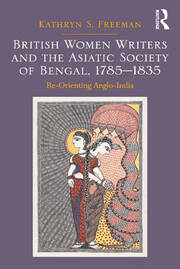
In her study of newly recovered works by British women, Kathryn Freeman traces the literary relationship between women writers and the Asiatic Society of Bengal, otherwise known as the Orientalists. Distinct from their male counterparts of the Romantic period, who tended to mirror the Orientalist distortions of India, women writers like Phebe Gibbes, Elizabeth Hamilton, Sydney Owenson, Mariana...
Read moreIn her study of newly recovered works by British women, Kathryn Freeman traces the literary relationship between women writers and the Asiatic Society of Bengal, otherwise known as the Orientalists. Distinct from their male counterparts of the Romantic period, who tended to mirror the Orientalist distortions of India, women writers like Phebe Gibbes, Elizabeth Hamilton, Sydney Owenson, Mariana Starke, Eliza Fay, Anna Jones, and Maria Jane Jewsbury interrogated these distortions from the foundation of gender. Freeman takes a three-pronged approach, arguing first that in spite of their marked differences, female authors shared a common resistance to the Orientalists’ intellectual genealogy that allowed them to represent Vedic non-dualism as an alternative subjectivity to the masculine model of European materialist philosophy. She also examines the relationship between gender and epistemology, showing that women’s texts not only shift authority to a feminized subjectivity, but also challenge the recurring Orientalist denigration of Hindu masculinity as effeminate. Finally, Freeman contrasts the shared concern about miscegenation between Orientalists and women writers, contending that the first group betrays anxiety about intermarriage between East Indian Company men and indigenous women while the varying portrayals of intermarriage by women show them poised to dissolve the racial and social boundaries. Her study invites us to rethink the Romantic paradigm of canonical writers as replicators of Orientalists’ cultural imperialism in favor of a more complicated stance that accommodates the differences between male and female authors with respect to India.
Read less