





1st Edition
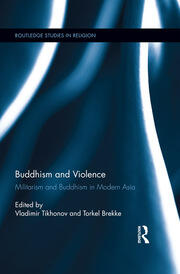
Buddhism and Violence Militarism and Buddhism in Modern Asia
Introduction: Dialectics of Violence and Non-Violence: Buddhism and Other Religions Vladimir Tikhonov Part I: Nationalism and Militarism in Modern Asian Buddhisms 1. Sinhala Ethno-nationalisms and Militarization in Sri Lanka Mahinda Deegalle 2. Military Temples and Saffron-Robed Soldiers: Securing Buddhism in Southern Thailand Marte Nilsen 3. Reconsidering the Historiography of Modern Korean Buddhism: Nationalism and Identity of the Chogye Order of Korean Buddhism Cho Sungtaek Part II: Militarism and the Buddhist Monks 4. The Thai Buddhist Monk as Representation of the Nation and Target of Violence Michael Jerryson 5. Canonical Ambiguity and Differential Practices: Buddhism and Militarism in Contemporary Sri Lanka Iselin Frydenlund 6. The Monks and the Hmong: The Special Relationship between the Chao Fa and the Tham Krabok Buddhist Temple in Saraburi Province, Thailand Ian Baird 7. A Closer Look at Zen at War: The Battlefield Chaplaincy of Shaku Sōen in the Russo-Japanese War (1904-1905) Micah Auerback Part III: Buddhist Justifications for Peace and Militarism 8. The Justification of Violence in Thai Buddhism Suwanna Satha-Anand 9. Buddhism and the Justification of War with Focus on Chinese Buddhist History Xue Yu 10. Anti-War and Peace Movements among Japanese Buddhists after the Second World War Kawase Takaya; translated by Micah L. Auerback 11. Violent Buddhism – Korean Buddhists and the Pacific War, 1937-1945 Vladimir Tikhonov Conclusion Torkel Brekke Notes on Contributors Notes Index
Biography
Vladimir Tikhonov is a Professor at Oslo University (UiO), Norway, working mainly in the areas of Korean Buddhist history and history of modern thought in Korea.
Torkel Brekke is a Professor at Oslo University (UiO), Norway, working mainly in the areas of the ethics of war in South Asian civilizations and comparative religion, including the problems of fundamentalism and religious violence.
This well-researched volume will definitely raise awareness of academics, policy makers, and students. At the same time, it deserves a wide readership, especially among general readers concerned with the nexus of Buddhism and violence". - Kai Chen, College of Public Administration, Zhejiang University, China, Journal of Global Buddhism
