




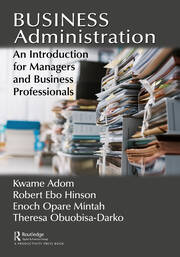

1st Edition
Business Administration An Introduction for Managers and Business Professionals
Contents
CHAPTER 1: BUSINESS AND ITS EXTERNAL ENVIRONMENT. 9
1.2 Defining Business Environment 10
1.3. The 21st Century Business Posture. 10
1.4. Types of Business Environment 11
1.4.1 The Internal Environment 12
1.4.2 The External Environment 13
CHAPTER 2: FORMS OF BUSINESS OWNERSHIP. 21
2.2.1 Advantages of Sole Proprietorship. 23
2.2.2 Disadvantages of Sole Proprietorship. 23
2.3.1 Advantages of Partnerships. 24
2.3.2 Disadvantages of Partnership. 25
2.4 Limited Liability Company. 25
2.4.1 Advantages of Limited Liability Companies. 26
2.4.2 Disadvantages of Limited Liability Companies. 26
2.5.1 Advantages of Business Corporations. 27
2.5.2 Disadvantages of Business Corporations. 27
CHAPTER 3: HOW TO START AND GROW A BUSINESS. 34
3.2 Stages in Business Formation and Growth. 35
3.3 Starting with the EndGame in Mind. 36
3.4 Preparatory Stage for Starting a Business. 37
3.5 Profile of an Entrepreneur 38
3.7 BUSINESS GROWTH AND EXPANSION.. 41
4.2.1 The Planning Process. 50
4.3 Policies and Procedures. 53
4.9.1 Types of Control systems. 76
CHAPTER 5: HUMAN RESOURCE MANAGEMENT. 89
5.6.2 Learning and Development (L & D) 95
5.6.3 Performance and Reward Management 95
5.6.4 Employee Relationship Management (ERM) 96
5.8 Importance of Human Resource Policies. 96
5.9 Specific Human Resource Policies. 97
CHAPTER 6: PRODUCTION AND OPERATIONS MANAGEMENT. 104
6.2.2 Classification of Production System.. 106
6.2.3 Types of production. 108
6.2.4 Factors of production. 108
6.3.1 Objectives of Production Management 110
6.4.1 Concept of Operations. 111
6.4.2 Distinction between Manufacturing Operations and Service Operations. 111
6.5.1 A Framework for Managing Operations. 112
6.5.2 Objectives of Operations Management 113
6.6 Scope of production and operations management 113
Chapter 7: Marketing Management 119
7.2.1 Characteristics of a market 120
7.2.2 Elements of a Market 120
7.3 CONCEPTS IN MARKETING.. 121
7.4 THE MARKETING PROCESS. 122
7.4.1 Situational analysis. 123
7.4.3 Marketing mix decisions. 123
7.4.4 Implementation and Control 123
7.5 PORTER’S FIVE FORCES MODEL.. 123
7.6 FUNCTIONS OF MARKETING MANAGEMENT. 126
7.7 THE MARKETING ENVIRONMENT. 128
7.7.1 The Internal Environment 128
7.7.2 The Micro-environment 128
7.7.3 The Macro-environment 128
7.8.1 Elements of a Marketing Plan. 129
7.8.2 Marketing objectives. 130
7.8.3 Strategies to achieve the objectives. 130
7.8.4 Tactical plan and budget 131
7.8.5 Implementation and evaluation - action plan. 131
7.9.1 The Research Process. 132
7.10 MARKET SEGMENTATION.. 133
7.11 THE PRODUCT LIFE CYCLE.. 134
7.12 BRANDING OF THE PRODUCT. 134
Chapter 8: Accounting and Financial Statements. 143
8.2 The Nature of Accounting. 144
8.2.2 Accounting Terminologies. 147
8.2.3 Reasons for Accounting. 150
Biography
Kwame Adom is an Associate Professor at the Burman University in Canada. He has acted as a Senior Lecturer at the Department of Marketing and Entrepreneurship at the University of Ghana Business School. He has several journal papers, book chapters and books to his credit. His research specialization is entrepreneurship and he can be reached at [email protected].
Robert E. Hinson is currently the Pro Vice-Chancellor at the Ghana Communication Technology University, having the joined that University from the University of Kigali where he acted as Deputy Vice Chancellor – Academic with additional responsibility as Interim Vice Chancellor. His main research interests lie in the academic areas of marketing and communications, information and technology management, service management, and social responsibility and sustainability management. He has 30 originally authored and edited volumes to his credit and his book collection can be accessed at www.robertebohinsonbooks.com. He can be reached on [email protected].
Enoch Opare Mintah is an Associate Lecturer at the University of Lincoln, UK and doctorate student at the Kingston University in the United Kingdom. He holds an MBA (University of Liverpool, UK), MSc Governance (University of Lincoln, UK) Cert. Hospitality and Tourism Management (Florida Atlantic University, USA) and a BA English (KNUST, Ghana). His research interests revolve around ESG disclosures, Sustainability Reporting, Corporate Social Responsibility, Nonprofit Leadership and Education. Enoch is a member of the British Accounting and Finance Association (BAFA), European Accounting Association (EAA), and the Institute of Corporate Responsibility and Sustainability (ICRS-UK). He can be reached at [email protected].
Theresa Obuobisa-Darko holds a Doctor of Philosophy in Public Administration and Policy Management, a Master of Philosophy in Public Administration as well as a Masters of Business Administration (Human Resource Management option), all from the University of Ghana. She has over thirty (30) years teaching and research experience in the field of Human Resource Management, Organisational Development and Public administration and has authored several journal articles and book chapters in these areas. She can be reached on [email protected].
