




1st Edition
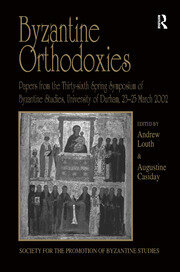
Byzantine Orthodoxies Papers from the Thirty-sixth Spring Symposium of Byzantine Studies, University of Durham, 23–25 March 2002
250 Pages
by
Routledge
250 Pages
by
Routledge
250 Pages
by
Routledge
Also available as eBook on:
The Byzantine Empire - the Christianized Roman Empire - very soon defined itself in terms of correct theological belief, 'orthodoxy'. The terms of this belief were hammered out, for the most part, by bishops, but doctrinal decisions were made in councils called by the Emperors, many of whom involved themselves directly in the definition of 'orthodoxy'. Iconoclasm was an example of such imperial... Read more
Contents: Preface; Introduction, Andrew Louth. Section I Defining Orthodoxy: The question of Nicene orthodoxy, John Behr; Gregory of Nazianzus as the authoritative voice of orthodoxy in the 6th-century, Caroline Macé; Theotokos-Diadochos, Dirk Krausmüller; Methodios and his synod, Patricia Karlin-Hayter; Prochoros Cydones and the 14th-century understanding of orthodoxy, Norman Russell. Section II Orthodoxy in Art and Liturgy: In the beginning was the Word...: art and orthodoxy at the Councils of Trullo (692) and Nicaea II (787), Leslie Brubaker; ...and the Word was with God...: what makes art orthodox?, Liz James; ...and the Word was God: art and orthodoxy in late Byzantium, Robin Cormack; The British Museum triumph of orthodoxy icon, Dimitra Kotoula; Medieval Byzantine chant and the sound of orthodoxy, Alexander Lingas; Byzantine hymns of hate, Archimandrite Ephrem (Lash). Section III Orthodoxy and the Other: Can we speak of Jewish orthodoxy in Byzantium, Nicholas de Lange; The apostolic foundation stone: the conception of orthodoxy in the controversy between Photius of Constantinople and Isaac surnamed Mrut, Igor Dorfmann-Lazarev; The orthodoxy of the Latins in the 12th century, Tia M. Kolbaba. Epilogue: Some constant characteristics of the Byzantine orthodoxy, Sergei Averintsev. Index.
Biography
Andrew Louth is Professor and Augustine Casiday is Leverhulme Fellow, both in the Department of Theology and Religion at the University of Durham, UK.
’... this volume is a welcome collection of careful research and clear expression on the orthodoxies we usually fail to recognize, whether in the Byzantine or other contexts. Andrew Louth's most insightful introduction, which sets the papers into the larger context of historical theology while also relating them to each other, is especially commended to the reader.’ Logos: A Journal of Eastern Christian Studies
