





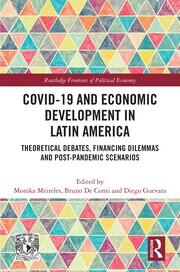
1st Edition
COVID-19 and Economic Development in Latin America Theoretical Debates, Financing Dilemmas and Post-Pandemic Scenarios
Introduction
Monika Meireles, Bruno De Conti and Diego Guevara
I. Rethinking Development and Financial Dependency: Theoretical Reflections
1. Dependency, Finance and Development: Echoes of the Past That Resonate in the Present
Manuel Felipe Martínez Mantilla and José Daniel Saade Figueroa
2. International Division of Finance: Functionality and Dependency of the System’s Periphery
Édivo de Almeida Oliveira and Bruno De Conti
3. Latin America: Between Regressive Structural Change and the Pandemic
Diego Guevara and Emilia Ormaechea
II. Financialization and Financial Reconfiguration in the Pandemic
4. Dependent Financialization of Latin America: A View from the COVID-19 Crisis
Armando Negrete
5. Latin American Development Banks in the Pandemic Crisis
Marcos V. Chiliatto and Daniela M. Prates
6. They Win in Mexico: Pension Funds and Financial Benefits during the Pandemic
Lizeth Alanis and Monika Meireles
III. Economic Policy Response to the COVID-19 Crisis
7. Potential of Coordination Between Monetary and Fiscal Policy: The Experience of Latin America during COVID-19
Leonardo Rojas Rodríguez and Santiago Castaño Salas
8. Countercyclical Fiscal Policy and Fiscal Impulses: Post-Pandemic Challenges - The Cases of Brazil and Mexico
Teresa López González and Eufemia Basilio Morales
9. Effects of International Liquidity Cycles on Argentina during the Pandemic
Ezequiel Greco Laplane
Biography
Monika Meireles holds a bachelor’s degree in Economics from the School of Economics of the University of São Paulo (FEA-USP for its acronym in Portuguese), and a master’s degree in Latin American Integration from the Graduate Program in Latina American Integration of the same institution (Prolam-USP for its acronym in Portuguese) and a doctorate from the Graduate Program in Latin American Studies of the National Autonomous University of Mexico (Ppela-UNAM for its acronym in Spanish). Currently she is a full time Senior Researcher A assigned to the Fiscal and Financial Economics Unit of IIEc-UNAM; member of the National System of Researchers (SNI for its acronym in Spanish) of Conacyt (level I) and she was awarded the Recognition of Distinction of the National University for Young Academics (RDUNJA for its acronym in Spanish) in the area of research in economic-administrative sciences in the 2019 edition.
Bruno De Conti, Associate professor of the Institute of Economics of the University of Campinas (Unicamp), Brazil. Investigator of the Center for Studies on Economic Current Affairs and Policy (Cecon for its acronym in Portuguese) and of the Center for Brazil-China Studies (CEBC for its acronym in Portuguese) of the same university. His main areas of research are: International Monetary System hierarchies; BRICS and China’s economy.
Diego Guevara, Associate Professor at the National University of Colombia with a doctorate in Economics from the same institution. He is professor of Macroeconomics and editor of the journal Cuadernos de Economía. His current research focuses on financialization in emerging countries and macroeconomics and the energy transition.
