




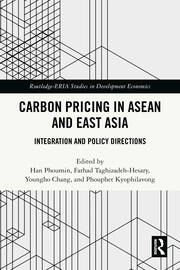
1st Edition
Carbon Pricing in ASEAN and East Asia Integration and Policy Directions
Introduction
Han Phoumin, Farhad Taghizadeh-Hesary, Youngho Chang, and Phouphet Kyophilavong
Section 1: National Approaches to Carbon Pricing and Market Development
1. Exploring the Viability and Policy Implications of Introducing Carbon Markets in Vietnam
Thai-Ha Le
2. Carbon Taxation in Singapore: Implementation, Impacts, and Implications
Youngho Chang
3. Carbon Pricing and Market Readiness in Thailand: A Policy Review of Taxation, Emissions Trading, and Voluntary Markets
Nophea Sasaki and Han Phoumin
4. Carbon Pricing in Indonesia: A Suboptimal Adoption Approach
Alin Halimatussadiah, Dandy Rizky Wibowo, and Akhmad Rizal Shidiq
5. The Carbon Market in Laos: The Opportunities and Challenges
Phouphet Kyophilavong, Inpaeng Sayvaya, Thongsa Tounmanysone, and Phongsili Soukchalern
6. Public Acceptance and Willingness to Pay for Carbon Pricing in Malaysia
Fathin Faizah Said
Section 2: Comparative Experiences and Analytical Frameworks
7. Evolution of Carbon Markets in Australia – Policy Lessons for the ASEAN Based on a Review of Design Features and Performance
Rabindra Nepal, Muhammad Tayyab Ayaz, Ashish Agalgaonkar, and Han Phoumin
8. Effective Carbon Pricing and Emissions Reduction in Japan: Lessons for East Asian Regional Integration
Satoshi Honma
9. CGE Analysis of the Joint Carbon Market in ASEAN and East Asia: Considering Policy Challenges in Market Development
Shinya Kato, Yanmin He, Wendan Zhang, Soocheol Lee, Toru Morotomi, Tsutomu Yoshioka, and Xu Han
10. Emission Trading System and International Capital Flows in ASEAN and East Asia: Evidence from Selected Countries
Solomon Nborkan Nakouwo, Yajie Chen, and Dayong Zhang
Section 3: Regional Integration and Market Linkages
11. How to Connect ASEAN Carbon Markets – Learnings from the European Union and China
Lutz Philip Hecker, Yanfei Li, Xueyan Yang, and Yuxuan Yu
12. Linking Carbon Markets in the ASEAN Countries: Potential Impacts, Challenges, and Opportunities for Regional Cooperation
Falendra Kumar
13. Malaysia’s Carbon Market and ASEAN: Opportunities and Challenges
Nora Yusma Mohamed Yusoff, Ahmad Khusyairi Che Rusli, Asiyyah Sakinah Dzulkifli, and Basil Sharp
Biography
Han Phoumin is a Senior Energy Economist at the Economic Research Institute for ASEAN and East Asia, Indonesia. He holds a PhD in Economic Development and Policy from Kobe University, Japan.
Farhad Taghizadeh-Hesary is Professor at Tokai University, Japan; Vice President and Co-founder of the International Society for Energy Transition Studies; and Chief Economist of Climate Finance Asia in Tokyo, Japan. He holds a PhD in Economics from Keio University, Japan.
Youngho Chang is an Associate Professor and Head of the Minor in Applied Economics at Singapore University of Social Sciences, Singapore. He holds a PhD in Economics (Environmental and Resource Economics) from the University of Hawaii at Manoa, USA.
Phouphet Kyophilavong is a Professor at the National University of Laos, Lao PDR. He holds a PhD in Economics from Kobe University, Japan.
