





1st Edition
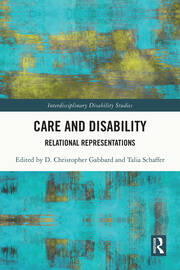
Care and Disability Relational Representations
Introduction
D. Christopher Gabbard and Talia Schaffer
Section One – Care Collectives: Choosing Kin
Chapter One – Caring Characters: Esther’s Effacement in Bleak House
Talia Schaffer
Chapter Two – Socrates’s Bath: Toward a Poetics of Attendance
Andy King
Chapter Three – Ancestral Care Work: Reimagining Disability Justice for Black Crip Queers
Kevin A. Blanks
Section Two – Critiquing Family Caregiving
Chapter Four – "The Very Staff of My Age, My Very Prop”: Care as Prosthesis in Shakespeare
Joseph Maddocks
Chapter Five – The Networked Family: Care and Form in Avni Doshi’s Burnt Sugar
Ajitpaul Mangat
Chapter Six – “Negotiating Care and Control: Impairment, Caregiving, and Surveillance in William Godwin’s Mandeville”
Lucy E. Thompson
Section Three – Articulating Care
Chapter Seven – “[G]ood people will take care of me”: Capacity and Care in the ‘Left-Hand Penmanship’ Contest of 1865–1867
T. K. Dalton
Chapter Eight – ‘Mary’s Washing-Tub Tales’: Disability and Communities of Care in Mary Prince’s History
Annika Mann
Chapter Nine – “Anile Dotage?” Communities of Care in William Wordsworth’s “The Idiot Boy”
Kathleen Béres Rogers
Section Four - Alternative Care Paradigms: Past Possibilities, Future Fantasies
Chapter Ten – “Nineteenth-Century, North American, Indigenous Voices of Disability: An Alternative Care Ethic”
Sara Newman
Chapter Eleven - “Disability and Collective Care in Charlotte Forten’s Civil War Writings”
Vivian Delchamps Wolf
Chapter Twelve – Ethics of Care, Disability, and Sex Work as Care Work in Tsai Ming-liang’s I Don’t Want to Sleep Alone and Days”
Nicholas de Villiers
Chapter Thirteen – From Double Bind to Monkeys’ Wedding: Care Work in Octavia E. Butler’s Dawn
D. Christopher Gabbard
Biography
D. Christopher Gabbard is a professor of English at the University of North Florida, whose work focuses on the intersection of disability studies and British eighteenth-century studies.
Talia Schaffer is a Distinguished Professor of English at Queens College, CUNY, and the Graduate Center, CUNY, whose work focuses on gender, disability, and domesticity in the Victorian novel.
