





Preface
About the Author
Symbols and Acronyms
Introduction to Polyurethanes
Introduction to Polyurethanes
Background
History
Chemistry of Polyurethanes
Introduction
Raw Materials
Prepolymers
Urea and Urethane Reactions
Chain Extension
Degradation
References
Health and Safety
Health and Safety
Introduction
Workplace
Prepolymer Preparation
Engineering
Safety Data Sheet Format
References
Processing
Prepolymer Production
Prepolymers
Laboratory Preparation
Commercial Preparation
One-Shot System
Quasiprepolymers
References
Processing Fundamentals
Introduction
Introduction to Molding Process
Health and Safety Concerns during Casting
Mold Preparation
Batch Size Adjustment
Prepolymer
Pigments and Additives
Curatives
Degassing
Mixing and Casting
Curing and Post Curing
Processing
Molding Methods
Bonding
Finishing
Plasticized Polyurethanes
Epoxy Polyurethane Blends
Cellular Polyurethane Elastomers
Polyurethane Processing Problems
Introduction
Observed Problems with Potential Causes
General Problem Solving
Mold Design
Bond Failure
Properties
Properties
Introduction
Physical Properties
Environmental
Electrical
Radiation
Chemical
Wear
References
Applications
Introduction
Major Type and Grade Selection
Polyurethane's Role in the Materials Field
Polyurethane Selection Criteria
Design
Summary
Tools for Evaluation
Introduction
Verification of Selected Grade
Quality Control Tests
Type Tests
Prototype and Service Tests
Investigative Research
References
Appendices
Abbreviations and Trade Names
Polyurethane Curatives
Mold Release Agents
Calculations
Molecular Weight
Equivalent Weight
Equivalent Weight of Blends of Polyols or Curatives
Weight Calculations
Acid Levels
Isocyanate Calculation
Chemical Structures
Glossary
Index
Biography
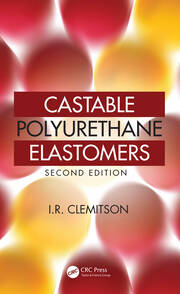
I.R. Clemitson has worked in the chemical industry for 45 years. Predominantly, he worked in the polymer industry, both in production and development, concentrating on rubbers and polyurethanes. In 1999, he received a master’s degree from the University of Technology in Sydney, Australia. His thesis was titled "The Influence of Polyurethane Chemistry on Erosive Wear." During this time, he was working at the R and D laboratory of Warman International in Sydney, Australia doing research into polyurethanes and other elastomers. In the concluding years of his full-time work, he was employed in the development and manufacture of polyurethane elastomers and foams. He also gave lectures at the local training institute and to industry on aspects of polyurethane and rubber technology. He has authored two books on polyurethane elastomers, namely Castable Polyurethane Elastomers and Polyurethane Casting Primer.
"Whether you are an experienced technologist or a beginner, this how-to book will serve as your bible. Castable polyurethane elastomers are an important and growing worldwide industry. The extent of the growth is due to constant improvements and innovations in both technology and manufacturing procedures. The reader will benefit from the logical sequence of polyurethane chemistry to the formulation of world-class castable elastomers."
—Michael Szycher, Ph.D, President, Sterling Biomedical, Inc., Lynnfield, Massachusetts, USA
"Written in simple language for hands-on practice. Provides details of processes and also solutions to problems. Safety and health is emphasized throughout the whole book."
—Wei Min Huang, Nanyang Technological University, Singapore"Whether you are an experienced technologist or a beginner, this how-to book will serve as your bible. ... The reader will benefit from the logical sequence of polyurethane chemistry to the formulation of world-class castable elastomers."
—FAPU European Polyurethane Journal - July 2015
