
1st Edition

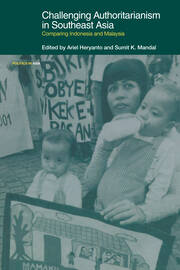
Challenging Authoritarianism in Southeast Asia Comparing Indonesia and Malaysia

Edited By Ariel Heryanto, Sumit K. Mandal Copyright 2003
260 Pages
by Routledge

256 Pages
by Routledge

Challenging Authoritarianism in Southeast Asia is one of the first substantial comparative studies of contemporary Indonesia and Malaysia, homes to the world's largest Muslim population. Following the collapse of New Order rule in Indonesia in 1998, this book provides an in-depth examination of anti-authoritarian forces in contemporary Indonesia and Malaysia, assessing their problems and... Read more
Acknowledgments List of Contributors 1. Challenges to Authoritarianism in Indonesia and Malaysia 2. Public Intellectuals, Media, and Democratization: Cultural Politics of the Middle Classes in Indonesia 3. Developing Dissent in Industrializing Localities: Civil Society in Penang and Batam 4. Changing State-Labour Relations in Indonesia and Malaysia 5. Islamization and Democratization in Malaysia in Regional and Global Contexts 6. The Blessed Tragedy: The Making of Women's Activism During the Reformasi Years 7. Creativity ion Protest: Arts Workers and the Recasting of Politics and Society in Indonesia and Malaysia References Appendix Glossary

Biography

Ariel Heryanto is Lecturer at the Melbourne Institute of Asian Languages and Societies, The University of Melbourne. Sumit K. Mandal is Research Fellow at the Institute of Malaysian and International Studies, Universiti Kebangsaan Malaysia.

'Together, the six essays and the incisive introduction provide some new ways of looking at authoritarianism in the region.' - Contemporary Southeast Asia

'Ariel Heryanto, Sumit Mandal and their co-writers are to be congratulated for the publication of this important book ... it offers the reader a serious and in-depth evaluation of the socio-political implications of the [reformasi].' - The Jakarta Post

'The well-researched material detailing some of the political and social dynamics at work within Indonesian and Malaysian civil society in the last decade are a significant contribution to our understanding of this period of great change.' - Intersections (Murdoch University)
