




1st Edition
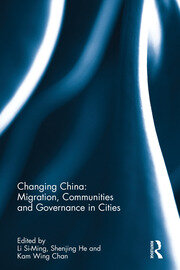
Changing China: Migration, Communities and Governance in Cities
1. Migration, Communities and Governance in Chinese Cities: Unfolding Forms and Processes
Si-ming Li, Shenjing He and Kam Wing Chan
Part I Circularity, Mobility and Precariousness
2. Instability of Labour Migrant Supply in China: Evidence from Source Area for 1987-1998
Yan Yuan, Zhao Rong, Ruidai Yang and Yan Liu
3. Residential Mobility within Guangzhou City, China, 1990-2010: Local Residents Versus Migrants
Si-ming Li and Yushu Zhu
4. Participation and Expenditure of Migrants in the Illegal Lottery in China’s Pearl River Delta
Zhiming Cheng, Russell Smyth and Gong Sun
Part II New Urban Diversities
5. The Effects of Residential Pattern and Chengzhongcun Housing on Segregation in Shenzhen, China
Pu Hao
6. Space to Manoeuvre: Collective Strategies of Indigenous Villagers in the Urbanizing Region of China
Jing Song
Part III Community and Local Governance
7. Neighbourhood Conflicts in Urban China: from Consciousness of Property Rights to Contentious Actions
Qian Fu
8. Homeowners’ Associations and Neighbourhood Governance in China
Shenjing He
9. Creating and Defending Concept of Home in Suburban Guangzhou
Dan Feng, Werner Breitung and Hong Zhu
Biography
Si-ming Li is currently Director of David C Lam Institute of East-West Studies and Chair Professor of Geography, Hong Kong Baptist University.
Shenjing He is an Associate Professor at the department of Urban Planning and Design, The University of Hong Kong.
Kam Wing Chan is Professor of Geography at the University of Washington.
