




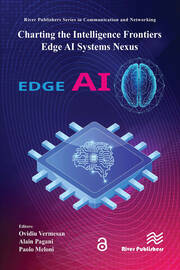
1st Edition
Charting the Intelligence Frontiers – Edge AI Systems Nexus
1. Edge AI Systems Verification and Validation
Ovidiu Vermesan, Alain Pagani, Roy Bahr, Marcello Antonio Coppola, and Giulio Urlini
2. Pioneering the Hybridization of Federated Learning in Human Activity Recognition
Alfonso Esposito, Yasamin Moghbelan, Ivan Zyrianoff, Leonardo Ciabattini, Federico Montori, and Marco Di Felice
3. Edge Intelligence Architecture for Distributed and Federated Learning Systems
Pierluigi Dell’Acqua, Lorenzo Carnevale, and Massimo Villari
4. Challenges and Performance of SLAM Algorithms on Resource-constrained Devices
Calvin Galagain, Martyna Poreba, and François Goulette
5. Designing Accelerated Edge AI Systems with Model Based Methodology
Petri Solanti and Russell Klein
6. EDGE AI Acceleration for Critical Systems: from FPGA Hardware to CGRA Technology
Pietro Nannipieri, Luca Zulberti, Tommaso Pacini, Matteo Monopoli, Tommaso Bocchi, and Luca Fanucci
7. Model Selection and Prompting Strategies in Resource Constrained Environments for LLM-based Robotic System
Toms Eduards Zinars, Oskars Vismanis, Peteris Racinskis, Janis Arents, and Modris Greitans
8. Optimising ViT for Edge Deployment: Hybrid Token Reduction for Efficient Semantic Segmentation
Mathilde Proust, Martyna Poreba, Calvin Galagain, Michal Szczepanski, and Karim Haroun
9. Recent Trends in Edge AI: Efficient Design, Training and Deployment of Machine Learning Models
Mark Deutel, Maen Mallah, Julio Wissing, and Stephan Scheele
10. Scalable Sensor Fusion for Motion Localization in Large RF Sensing Networks
Fetze Pijlman
11. Multi-Step Object Re-Identification on Edge Devices: A Pipeline for Vehicle Re-Identification
Tomass Zutis, Peteris Racinskis, Anzelika Bureka, Janis Judvaitis, Janis Arents, and Modris Greitans
12. A TinyMLOps Framework for Real-world Applications
Mattia Antonini, Massimo Vecchio, and Fabio Antonelli
13. Transfer and Self-learning in Probabilistic Models
Fetze Pijlman
14. A Novel Hierarchical Approach to Perform On-device Energy Efficient Fault Classification
Devesh Vashishth, Julio Wissing, and Marco Wagner
15. Discovering and Classifying Digital and Wooden Industries Products’ Defects at the Edge by a Yolo/ResNet-based Approach and Beyond
Robin Faro, Alessandro Strano, and Francesco Cancelliere
16. Conscious Agents Interaction Framework for Industrial Automation
Polina Ovsiannikova and Valeriy Vyatkin
17. Neuromorphic IoT Architecture for Efficient Water Management
Mugdim Bublin, Heimo Hirner, Antoine-Martin Lanners, and Radu Grosu
18. Online AI Benchmarking on Remote Board Farms
Maïck Huguenin, Baptiste Dupertuis, Robin Frund, Margaux Divernois, and Nuria Pazos
19. Optimizing Neural Networks for Water Stress Prediction in Europe: A Sustainable Approach
Laura Sanz-Martín, Manal Jammal, and Javier Parra-Domínguez
20. The Accountability Strikes Back: Decentralizing the Key Generation in CL-PKC with Traceable Ring Signatures
Varesh Mishra, Aysajan Abidin, and Bart Preneel
Biography
Dr. Ovidiu Vermesan holds a PhD degree in microelectronics and a Master of International Business (MIB) degree. He is Chief Scientist at SINTEF Digital, Oslo, Norway. His research interests are intelligent systems integration, mixed-signal embedded electronics, analogue neu-ral networks, edge artificial intelligence and cognitive communication systems. Dr. Ver-mesan received SINTEF’s 2003 award for research excellence for his work on implementing a biometric sensor system. He is currently working on projects addressing nanoelectronics, integrated sensor/actuator systems, communication, cyber-physical systems (CPSs) and the Industrial Internet of Things (IIoT), with applications in green mobility, energy, autonomous systems, and smart cities. He has authored or co-authored over 100 technical articles and conference papers. He is actively involved in the activities of the European partnership for Key Digital Technologies (KDT) Joint Undertaking (JU), now the Chips JU. He has coordinat-ed and managed various national, EU and other international projects related to smart sensor systems, integrated electronics, electromobility and intelligent autonomous systems such as E3Car, POLLUX, CASTOR, IoE, MIRANDELA, IoF2020, AUTOPILOT, AutoDrive, Archi-tectECA2030, AI4DI, AI4CSM. Dr. Vermesan actively participates in national, Horizon Eu-rope and other international initiatives by coordinating and managing various projects. He is a member of the Alliance for AI, IoT and Edge Continuum Innovation (AIOTI) board. He is currently the coordinator of the Edge AI Technologies for Optimised Performance Embedded Processing (EdgeAI) project.
Dr. Alain Pagani is Principal Researcher and deputy director of the Augmented Vision research department at the German Research Center for Artificial Intelligence (DFKI). His research interests include artificial intelligence, computer vision, image understanding, and extended reality. He is the coordinator of the Network of Excellence dAIEDGE regarding distributed AI at the edge, and the coordinator of the Horizon Europe project CORTEX2 regarding remote cooperation using extended reality. He is a lecturer at the University of Kaiserslautern-Landau, and he has published over 100 articles in conferences and journals. His research finds applications in eXtended Reality for tele cooperation (project CORTEX2), artificial intelligence and computer vision for human–robot cooperation (project FLUENTLY), artificial intelligence and augmented reality for analysis of extremely large data (project ExtremeXP). Since 2023, he has been a Research Fellow at DFKI, which is a recognition for outstanding scientific achievements and special achievements in technology transfer.
Dr. Paolo Meloni is currently associate professor at the Department of Electrical and Electronic Engineering (DIEE) at the University of Cagliari. He is author of several international papers and tutor of many bachelor and master students’ thesis in Electronic Engineering. His research activity is mainly focused on the development of advanced digital systems and programming of multi-core on-chip architectures, with emphasis on the application-driven design and programming of SoCs and FPGAs.
