




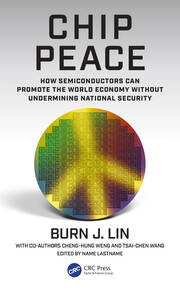
1st Edition
Chip Peace How Semiconductors Can Promote the World Economy Without Undermining National Security
Chapter 1 Introduction Chapter 2 Tremendous Potential of the Semiconductor Technology Chapter 3 Why Is IC Manufacturing so Difficult? Chapter 4 Keys to Growth for the Semiconductor Industry Chapter 5 Keeping Semiconductor Industry Healthy Chapter 6 Win-Win for Everyone Appendix
Biography
Burn J. Lin is a pioneering semiconductor engineer and the Dean of the College of Semiconductor Research at National Tsing Hua University, where he also serves as Director of the NTHU-TSMC Joint Research Center. After a Bachelor of Science degree in Taiwan, Dr. Lin earned his doctorate in electrical engineering from Ohio State University in 1970 and spent over two decades at IBM. He became a US citizen in 1970, before founding Linnovation, Inc. in 1991, then joined TSMC in 2000, rising to Vice President and Distinguished Fellow, where he played a crucial role in advancing immersion lithography technology that revolutionized semiconductor manufacturing. A member of both the US National Academy of Engineering and Taiwan's Academia Sinica, Dr. Lin has dedicated over half a century to extending the limits of optical lithography and is widely recognized as one of the most influential figures in modern semiconductor technology development.
Cheng-Hung Weng is a senior corporate strategy and marketing manager with nearly 30 years of experience in the electronics industry and semiconductor engineering. He holds both a Master’s degree in Electrical Engineering from NTOU and an Executive MBA from NTU and Fudan University. His career spans system engineering, R&D leadership, chip product marketing, and corporate planning, now focusing on strategic marketing analysis. Recognized with the Taiwan MOE Excellence Award and the Mediatek ISCA Contribution Award, he enjoys cycling, water sports, badminton, and independent travel.
Tsai-Chen Wang is the Chief Audit Executive (CAE) of a global high-tech group and a doctoral researcher focusing on corporate governance and sustainability. She holds a Master of Science in Information Systems and has over a decade of IT management and international assignment experience. She is also an honorary member of the Phi Tau Phi Scholastic Society and a Certified Internal Auditor (CIA).
"An enlightening book by a chip expert detailing why no country has all the expertise required to make chips. The unfettered transfer of ancient Chinese inventions like paper, printing advanced global technology worldwide over the centuries. Healthy competitions on chips are suggested by the author benefitting humanity and promoting peace."
Ken P. Chong, PhD, PE, F.ASME, F.AAM, Dist.M.ASCE, Research Professor, The George Washington University
"Over decades, semiconductor innovation has reshaped industries and fueled economic development through global cooperation grounded in diverse expertise and shared gains, rather than war or geopolitics. In Chip Peace, academician Burn Lin articulates that chips can foster peace among nations."
Huang Huang-Hsiung, Chairman of Taipei School of Economics and Political Science Foundation"Many economies around the world saw a historic growth in 2025 despite supply chain rearrangement, tariff wars, and geopolitical conflicts. Chip Peace reminds us of the vital importance of substantive collaboration across industry, academia, and public agencies globally particularly in the pursuit of technological sovereignty."
W. John Kao, President and CL Liu Chair Professor of National Tsing Hua University
“Prof. Burn Lin, in his book Chip Peace, explicitly puts forward a powerful antidote to those who see as inevitable or, even worse, would wish for a bifurcated world in the production of and access to semiconductors. As an outstanding pioneer in semiconductor manufacturing technology, he brings a deep technical perspective to argue the counter-case for a unified and shared global market for semiconductors as a positive force for change and progress. He exemplifies the moral intersection of technology and a vision for the future of our world. This is a courageous, timely and highly significant statement, founded on science and coming from the heart.”
Paul G. Clifford, External Associate, Lau China Institute, King’s College London
