




1st Edition
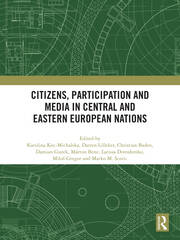
Citizens, Participation and Media in Central and Eastern European Nations
Introduction: Citizens, Participation and Media in Central and Eastern European Nations
Karolina Koc-Michalska, Darren Lilleker, Christian Baden, Damian Guzek, Marton Bene, Larissa Doroshenko, Miloš Gregor and Marko M. Scoric
Part I: Central and Eastern Europe in a Comparative Perspective
1. Social media, quality of democracy, and citizen satisfaction with democracy in Central and Eastern Europe
Matthew Placek
2. Patterns of Negative Campaigning during the 2019 European Election: Political Parties’ Facebook Posts and Users’ Sharing Behaviour across Twelve Countries
Paweł Baranowski, Simon Kruschinski, Uta Russmann, Jörg Haßler, Melanie Magin, Bene Márton, Andrea Ceron, Daniel Jackson & Darren Lilleker
3. One conflict, two public spheres, three national debates: comparing the value conflict over judicial independence in Europe across print and social media
Stefan Wallaschek, Kavyanjali Kaushik and Monika Eigmüller
Part II: Country case studies
4. Interactive Election Campaigns on Social Media? Flow of Political Information Among Journalists and Politicians as an Element of the Communication Strategy of Political Actors
Kinga Adamczewska
5. The audience logic in election news reporting on Facebook: what drives audience engagement in transitional democracies of Albania and Kosovo?
Lindita Camaj, Erlis Çela and Gjylie Rexha
6. One way or another? Discussion disagreement and attitudinal homogeneity on social networking sites as pathways to polarization in Czechia
Alena Macková, Martina Novotná, Lucie Čejková and Lenka Hrbková
7. Soros’s soldiers, slackers, and pioneers with no expertise? Discursive exclusion of environmental youth activists from the digital public sphere in Hungary and Czechia
Lenka Vochocová, Jana Rosenfeldová, Anna Vancsó and Annamária Neag
8. Like, Share, Comment, and Repeat: Far-right Messages, Emotions, and Amplification in Social Media
Larissa Doroshenko and Fangjing Tu
9. Donetsk don’t tell – ‘hybrid war’ in Ukraine and the limits of social media influence operations
Lennart Maschmeyer, Alexei Abrahams, Peter Pomerantsev and Volodymyr Yermolenko
Biography
Karolina Koc-Michalska is Professor at Audencia Business School and Affiliated Researcher at CEVIPOF Sciences Po Paris, France, and University of Silesia, Poland. She studies the strategies of political actors in the online environment and citizens’ political engagement. She employs a comparative approach focusing on the United States and European countries.
Darren Lilleker is Professor of Political Communication and Bournemouth University, UK, Co-Editor of the Journal of Visual Political Communication and Director of the Centre for Comparative Politics and Media Research.
Christian Baden is Associate Professor at the Department of Communication and Journalism at the Hebrew University of Jerusalem. His research focuses on the collaborative construction of meaning in dynamic, political public debates, with specific emphasis on the modeling and measurement of textual discourse.
Damian Guzek is an associate professor in digital media and communication at the University of Silesia in Katowice. His research is driven by questions related to media consumption and digital media, religions, and politics.
Márton Bene (Ph.D.) is a senior research fellow at the Centre for Social Sciences, Hungarian Academy of Sciences Centre of Excellence, and an assistant professor at the Faculty of Law, Eötvös Loránd University (ELTE). His research interests are in political communication, social media and politics, and political behavior.
Larissa Doroshenko is Postdoctoral Teaching Associate at Northeastern University, United States. Her research interests are centered on the effects of new media on political campaigning, with a particular focus on "the dark side" of the Internet: populism, nationalism and disinformation campaigns.
Miloš Gregor is an assistant professor at the Department of Political Science, Faculty of Social Studies, Masaryk University. He is dealing with topics such as political communication and marketing, propaganda, disinformation, and fake news.
Marko M. Skoric is Associate Professor at the Department of Media and Communication, City University of Hong Kong, where he leads the Political Communication and Culture Research Cluster and acts as the Ph.D. Program Coordinator. His research interests are focused on new media and social change, with a particular emphasis on the civic and political implications of digital technologies. He holds a Ph.D. in Communication from the University of Michigan and a B. Sc. in Psychology from the University College London.
