





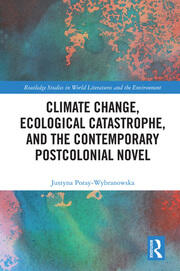
1st Edition
Climate Change, Ecological Catastrophe, and the Contemporary Postcolonial Novel
Introduction
Chapter 1: Reading Catastrophe through Postcolonialism, Ecocriticism, and Animal Studies
Chapter 2: Catastrophe, Vulnerability, and Human Relationships
Part 1: Kiran Desai’s The Inheritance of Loss
Part 2: Kim Scott’s Benang: From the Heart
Chapter 3: Catastrophe and Human-Nonhuman Relationships in Degraded Environments
Part 1: Uzma Aslam Khan’s Thinner than Skin
Part 2: Alexis Wright’s Carpentaria
Chapter 4: Land Justice, Resistance, Recovery
Part 1: Amitav Ghosh’s The Hungry Tide
Part 2: Patricia Grace’s Potiki
Conclusion
Biography
Justyna Poray-Wybranowska holds a PhD in English and World Literature from York University, with a specialization in environmental humanities, postcolonial studies, disaster studies, and animal studies. The research on which this book is based was jointly funded by the Social Sciences and Humanities Research Council of Canada and by York University. Poray-Wybranowska’s research has been published in ISLE: Interdisciplinary Studies in Literature and Environment (2020), Shifting Grounds: Cultural Tectonics along the Pacific Rim (2020), Otherness: Essays and Studies (2016), Studies in Canadian Literature (2014), HARTS & Minds (2014), and Just Politics? (2014).
"In her first monograph, Climate Change, Ecological Catastrophe, and the Contemporary Postcolonial Novel, Justyna Poray-Wybranowska offers a revised understanding of catastrophe in postcolonial fiction… a timely addition to a recent wealth of publications in the field of postcolonial ecocriticism."
-- Demi Wilton, Loughborough University, UK
“Poray-Wybranowska’s Climate Change, Ecological Catastrophe, and the Contemporary Postcolonial Novel is scholarly, with a well-articulated argument supported succinctly by relevant theory… This is an avenue of enquiry of increasing importance that has the potential to connect cross-disciplinarily with studies in social theory, ecocriticism, literatures of climate change, and interdisciplinary studies across the environmental humanities.”
--Kate Judith, University of Southern Queensland, Australia
