




1st Edition
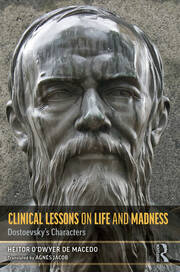
Clinical Lessons on Life and Madness Dostoevsky's Characters
Table of Contents
Preamble
Chapter 1 Notes from Underground
Chapter 2 Crime and Punishment
Chapter 3 The Double
Chapter 4 The Idiot
Chapter 5 Demons
Chapter 6 The Brothers Karamazov
Chapter 7 Women in Dostoyevsky’s Fiction
Chapter 8 The Grand Inquisitor
References
Biography
Heitor O’Dwyer de Macedo is a French psychoanalyst and former theatre director of Brazilian origin, based in Paris. He has worked both in an institutional context, with psychotic patients, and in private practice.
Located in the space between the raw reality of treating psychosis and Dostoevsky’s powerful work, this book takes us to the intersection of unnamable anguish where the characters encounter the unconscious. Determined to delve into the spheres that Freud, focused on neurosis, left unexplored - trauma and madness - Heitor O’Dwyer de Macedo, with his love of literature and the acute perception of an exceptional clinician, takes us across zones filled with the cumbersome hatred of the dead, to show us that these zones can open unto love and desire. This book is essential for clinical practice, and will delight all those who find the unconscious endlessly fascinating.
Anna Angelopoulos, psychoanalyst, anthropologist, President of the Fédération des Ateliers de Psychanalyse (Federation of Psychoanalytic Workshops), Paris; renowned researcher in the oral tradition of storytelling.
In this book, psychoanalyst Heitor O’Dwyer de Macedo shows us that Dostoevsky, the brilliant clinician, describes psychic processes that Freud would only formulate decades later. In simple language, de Macedo also points out that Dostoevsky’s novels deal essentially with the desire to establish vibrant relationships with others, without letting ideology replace lost religion.
Michel Eltchaninoff, philosopher, editor in chief of Philosophie Magazine
With his considerable clinical experience and vast knowledge of literature, the author ponders the mysteries of the human soul as they are revealed by Dostoevsky. Psychoanalysis and literature are both enriched as a result. We have here what Sartre would call the work of a master.
Ronaldo Lima Lins, writer, professor emeritus of literature at the Federal University of Rio de Janeiro
